

The insulation crew is booked for Friday. On Wednesday's inspection list are an open plumbing chase, a reluctant hatch and a bathroom duct that still needs attention.
"So Friday is the finish," Pat says, "not the start of the thinking."
Find and resolve the concealed problems before adding insulation. Fibrous insulation slows heat flow; it does not reliably seal an open chase or fix an exhaust route. Inspection, repairs, air sealing and eave preparation need to happen before the new blanket makes them harder to reach.
First Find What Should Not Be Covered
Before work, identify active roof or plumbing leaks, disconnected exhaust ducts, suspect insulation, unsafe wiring and chimney or lighting clearance issues. These can change the scope and the safe method of access.
If granular insulation may be vermiculite, stop disturbance and obtain assessment. If a recessed light's rating is unknown, have it identified before anyone buries it. A tidy top-up is not an improvement when it hides an unresolved hazard.
Ask for this preliminary inspection in the quotation. "Insulate to the stated depth" does not necessarily include any of these repairs.
Before agreeing to vacuum the whole attic, separate insulation condition from access needed for the repair.
Name the Air-Sealing Locations
Compare two completion photographs. One shows an even new blanket from eave to eave. The other set also shows the sealed ceiling openings before that blanket went down. The second tells you what happened underneath. Once the work is covered, insulation depth cannot reveal whether the crew repaired a bypass or simply buried it.
Common targets include the hatch perimeter, wall-top connections, plumbing penetrations, duct penetrations and open chases. Each needs a detail suited to its material and function. Chimneys and electrical equipment require particular treatment; one can of foam is not a complete specification.
The ENERGY STAR air-sealing guide highlights large hidden bypasses and knee-wall connections. Accessible openings can be treated now; concealed ones need to be identified as unfinished work rather than quietly counted as sealed.
If a blower-door assessment is included, establish how its findings guide the repairs and what follow-up measurement will check them.
If the attic adjoins an attached garage, review the garage-to-house air separation as a distinct connection.
The Plumbing Stack Has Two Separate Seals
The roof boot keeps rain out where the pipe crosses the roof. The ceiling-level seal keeps room air from travelling around the pipe into the attic. Replacing the boot does not close the lower opening.
A small gap around a pipe differs from a large open chase. The latter needs a supported closure, with appropriate sealing at its perimeter and penetrations. NRCan's attic guidance describes flexible arrangements for plastic stacks that move with temperature. The selected detail must also suit the surrounding assembly and any fire-separation requirements.
Air sealing concerns the space outside the pipe. It must not cap or narrow the plumbing vent. Damaged plumbing belongs with a qualified plumber. Ask the report to distinguish rain tracking down the pipe from air leakage around its ceiling penetration, and request photographs before insulation covers the repair.
Seal the lower boundary first
The ceiling air barrier sits beneath the insulation. Adding insulation leaves an open hatch or ceiling gap on the wrong side of the repair.
Schematic view. Shows relationships, not installation dimensions.
Preserve the Eave Route
The new insulation level may be deeper than the old one. Baffles and hatch borders need to suit that finished depth. A previously visible baffle outlet can become buried if no one adjusts it before the hose arrives.
The insulation specification should identify the material, intended thermal resistance and the coverage or installed quantity needed to achieve it. Depth alone is not equally meaningful for every product or installation condition.
Set the Trade Dependencies Before the Top-Up
Name who handles each unresolved item: exhaust duct routing, light ratings and clearances, the hatch closure and eave baffles. A subcontractor arriving only to blow insulation may not be responsible for those repairs.
List concealed or inaccessible areas separately, including the access needed to address them later. A completed accessible-area scope should not be described as every bypass in the house sealed. At handover, keep both the air-sealing photographs and insulation record; one cannot stand in for the other.
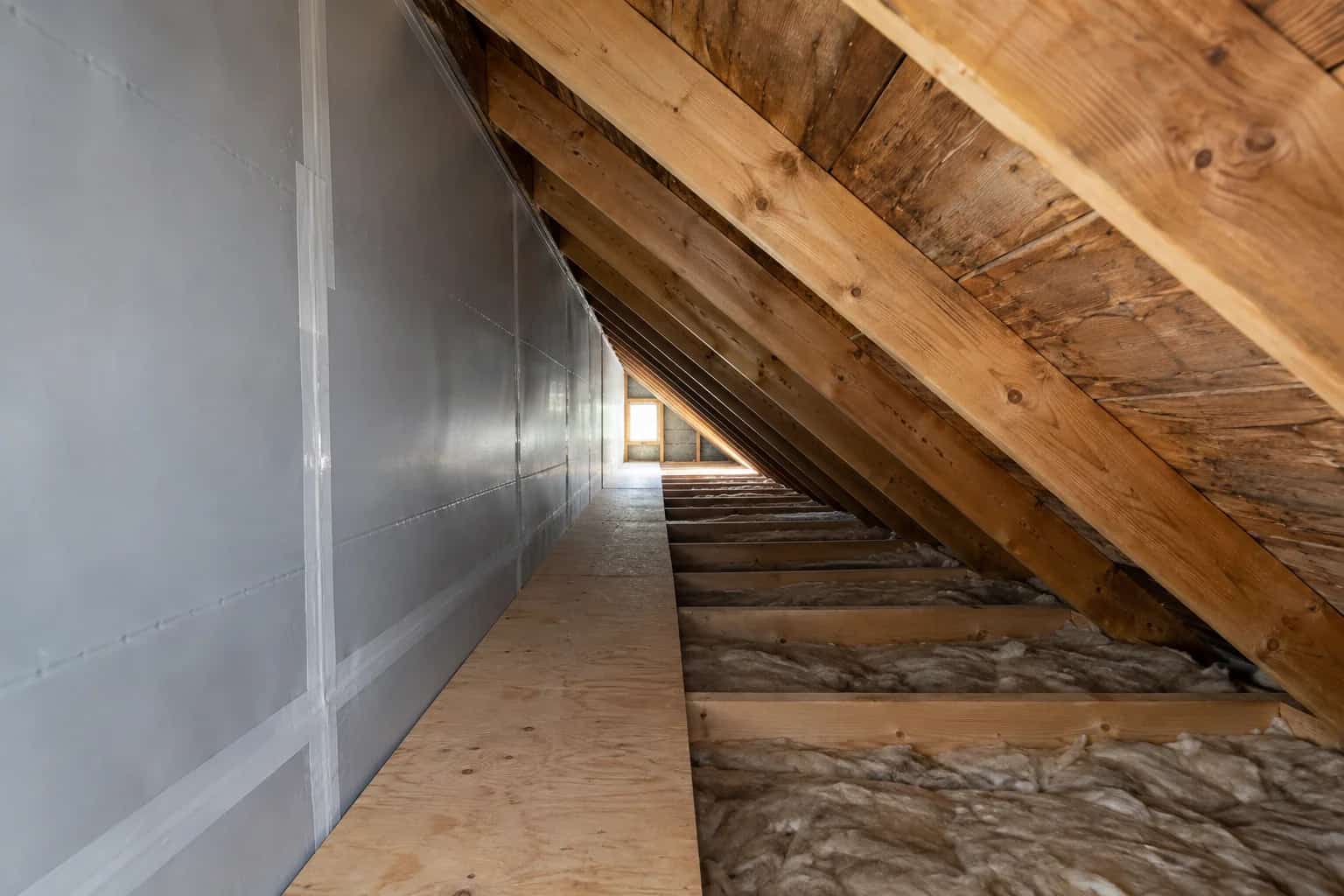
The photos to keep
The handover folder includes the tidy finished insulation and the untidy-looking openings from before it went down. Keep both. The less attractive photographs show what was actually repaired, and the inaccessible-area list tells the next crew where the story is unfinished.
Keep the material information, installed quantity, photographs and list of inaccessible areas. Ask who is responsible for restoring any duct, hatch or protective cover moved during the job. A final walk-through from safe access should check that service items remain reachable and the hatch closes properly.
Our hatch guide is a useful small-scale example of the same principle: insulation and air sealing have different jobs and need to meet at the opening.