
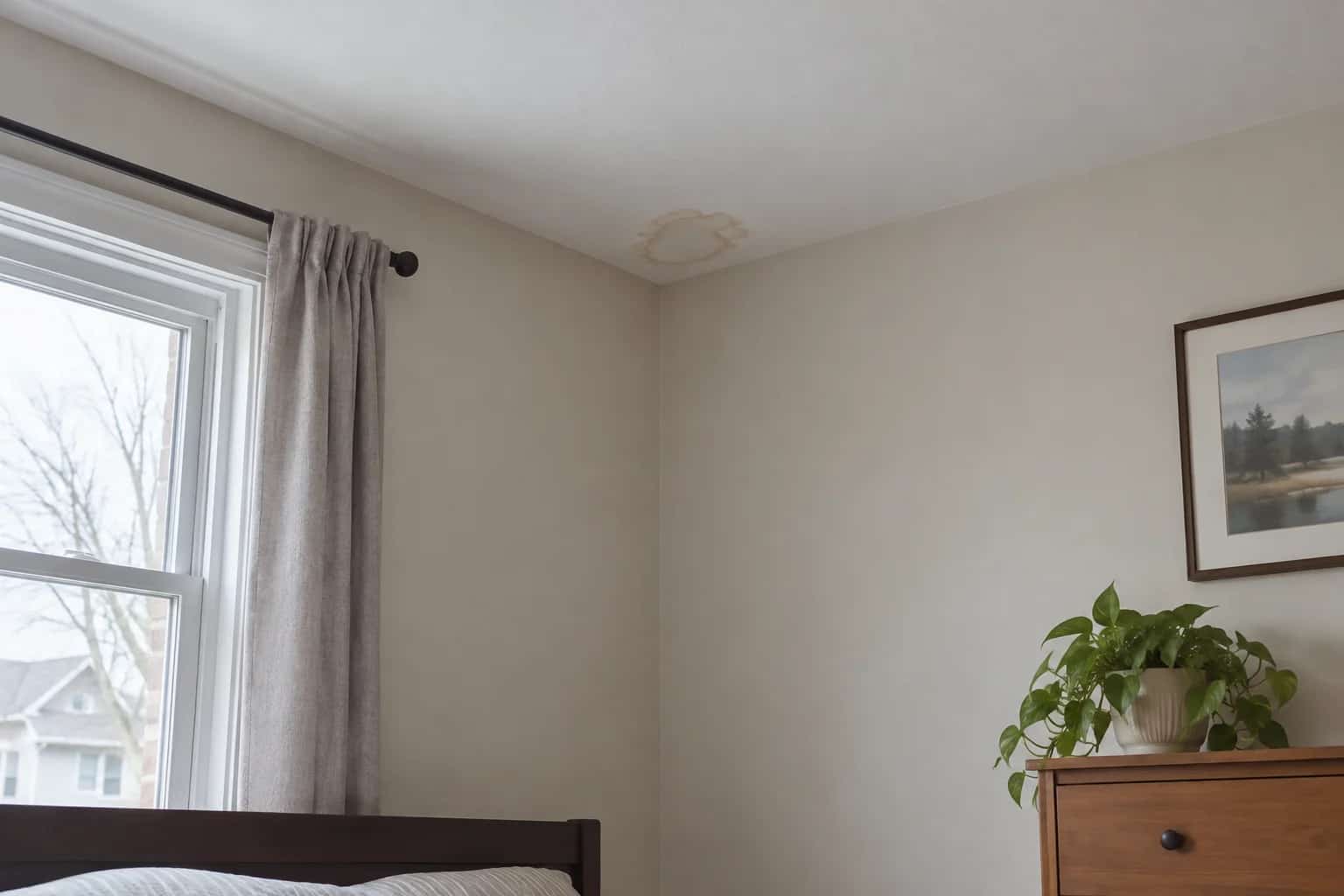
The ceiling stain has stopped spreading, and someone has already brought out a paint swatch. Mike puts the swatch back on the table. "We have established that we like white. We have not established that the ceiling is dry." Whether wet drywall can stay depends on its condition, the water and what happened behind it.
A small brown ring does not automatically require a whole new ceiling. A heavy sag does not become sound board merely because its surface eventually dries. Assess the board, exposure and hidden assembly before deciding what stays.
Assess the board's condition, the water exposure and the hidden assembly before choosing drying or replacement. The source repair and the ceiling repair are separate jobs. Stop the water promptly, keep people away from a bulging area and do not puncture it to see what is inside.
When Drying in Place Is Worth Considering
The US EPA's drying guidance allows drywall to dry in place when it has no obvious swelling and its seams remain intact. It also identifies the cavity behind the board as the difficult part to dry. That guidance concerns clean-water damage; contaminated water needs a different assessment.
Mike would distinguish brief local wetting, caught early with sound flat board and access for a restoration professional to assess the back and nearby materials, from repeated hidden leakage. Retention may be reasonable. With repeated leakage into insulation above an inaccessible ceiling, the repair question changes. The neat little mark below does not describe that larger job.
USG does not require removal of its gypsum panels solely because they were once wet. It calls for a qualified, project-specific decision and warns that prolonged or repeated wetting can leave conditions for mould. Neither source supports a blanket promise that every ceiling can be saved if a fan arrives within a particular number of hours.
Damage That Changes the Decision
Visible sagging, swelling, opened seams or loss of integrity push the assessment beyond stain removal. Contamination and suspected mould also change the scope. Rain that started outdoors should not automatically be treated as clean after travelling through dirty concealed spaces.
The assessment should separate three questions:
- Is the board physically serviceable?
- Can the affected board and concealed materials be adequately dried and checked?
- Can any contamination be addressed appropriately without retaining damaged material?
A yes to the first does not answer the other two. Equally, a permanent colour mark on otherwise sound, properly assessed material is not by itself proof that moisture is still entering.
If the home cannot be safely occupied, ask separately about temporary accommodation approval and expense records while the repair scope is assessed.
Three Checks Before Keeping the Board
Retaining a ceiling needs a sound answer at every stage, not just a dry-looking face.
Physical condition
Assess swelling, sagging, seams and the board's integrity.
Exposure and contamination
Establish what water reached it and whether cleanup is feasible.
Concealed drying
Assess the back, cavity and adjoining materials rather than only the paint.
Restore and finish
Complete the assembly after the source and affected materials are addressed.
What Happens Above the Patch?
Removing a small section can reveal wet insulation, framing or an affected air-control layer. Those findings may change the repair boundary. Replacing only the visible rectangle while enclosing wet material above it leaves the important work unfinished.
That is why the drying or removal scope should name the concealed layers being assessed and who will restore them. Our wet-insulation guide covers that adjoining decision. Older unidentified materials should be assessed before disturbance; do not start cutting solely to improve access for a household fan.
The awkward bit is the cavity nobody can see. A neat surface can conceal wet material, while a lingering mark can remain after drying. Dave wants evidence about the material, not a contest over whose thumb thinks the paint feels driest.

Repaint When the Assembly Is Ready
Health Canada advises fixing moisture sources and addressing affected materials. Stain-blocking primer belongs after that work, not in place of it.
Before finishing, obtain the drying findings and any remaining exclusions. Measurements should identify their locations and method; a meter number alone is not a drying certificate. The chosen board, joints, insulation and air-control details also need reinstatement where disturbed.
The least disruptive repair is the smallest complete repair, not necessarily the smallest opening. If a larger opening is needed, the explanation should be the condition found and the work it permits, rather than a general dislike of stained ceilings.
Keep the paint swatch. Just let the moisture assessment finish first. Our preferred order is a sound, dry assembly followed by a ceiling you can stop watching every time it rains.