
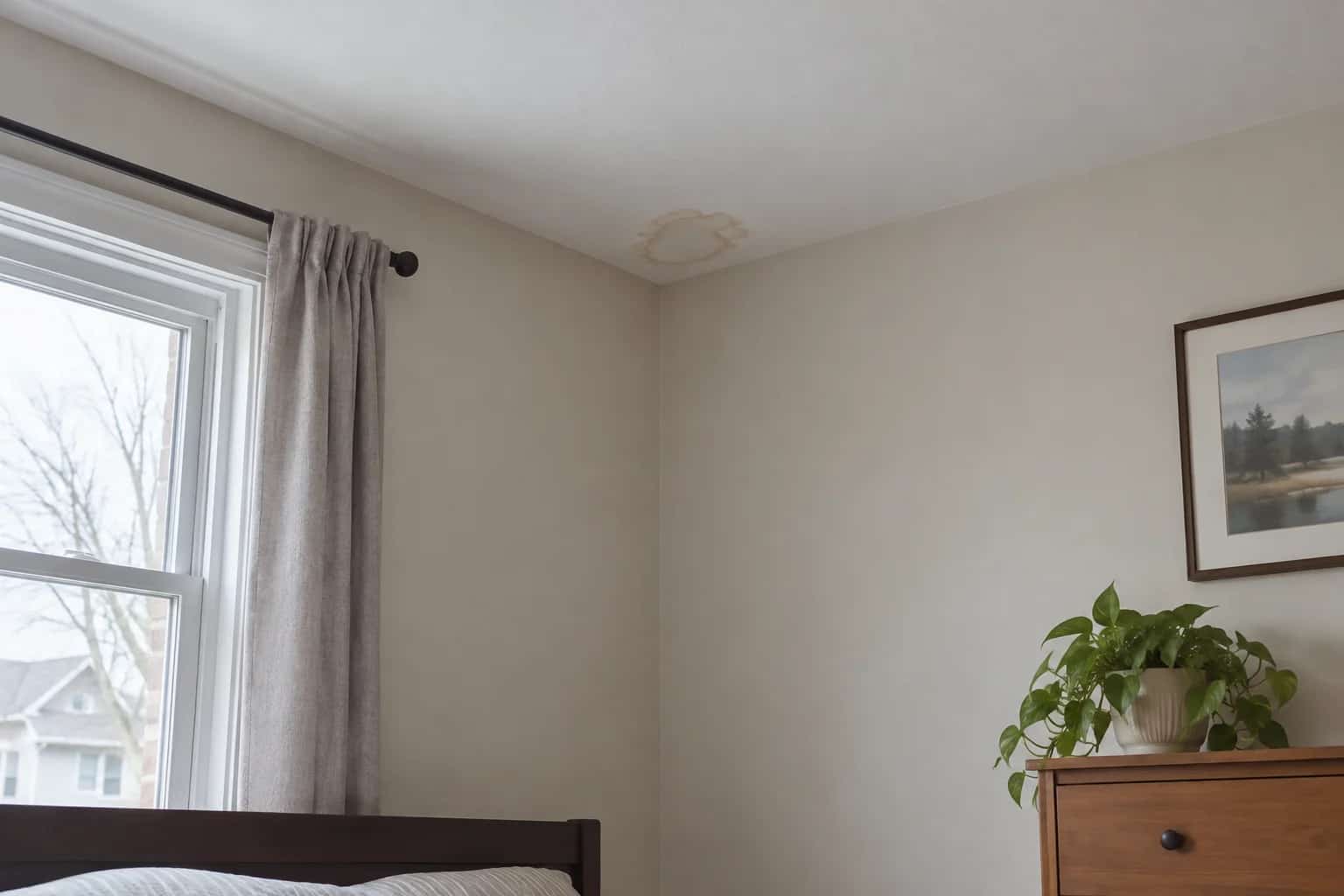
The moisture meter says 72. The homeowner looks at Mike as though the ceiling has just failed an exam. "Seventy-two what?" he asks. That is the useful question: a meter reading needs its scale, material and comparison before it can tell you anything useful about a ceiling.
A number without the instrument mode and material is incomplete information. Many pinless meters use a relative scale. A reading of 72 on that scale does not mean the ceiling contains 72 percent water, and it cannot identify whether any moisture came from the roof, a pipe or condensation.
First, Find Out Which Scale You Are Seeing
Pin meters use probes that contact the material. Their interpretation depends on the instrument, selected material and any required correction. A wood-moisture mode is not automatically a calibrated drywall percentage. Protimeter explains wood moisture equivalent, or WME: a non-wood material can be expressed relative to wood rather than as its actual percentage of water.
Pinless instruments scan without making probe holes. FLIR describes its pinless readings as relative measurements that should be compared with a known dry area of the same material, thickness and construction. Its support guidance explains relative values and dry comparisons.
Mike asks the assessor to name the mode and the comparison area. The homeowner does not need to buy a matching instrument or learn its entire manual; the explanation needs to make this reading understandable.
The homeowner starts marking every high reading with a cross. Dave suggests numbering the locations instead. "We might want to come back to the same place without turning the ceiling into a treasure map." The numbers go on a sketch, alongside the material and meter setting. Now another visit can compare like with like.
A Small Map Is Better Than One Alarm
Imagine three labelled positions on a ceiling: A at an unaffected comparison area, B at the stain's edge and C near its centre. On a fictional relative scale, A reads 18, B reads 39 and C reads 72. Those example numbers have no pass/fail meaning. They show why the pattern is more informative than the largest number.
That numbered sketch earns its keep on the return visit. The assessor can use the same locations and method rather than wave the meter around until a lower number appears. A report saying only "ceiling: 72" cannot establish whether a later 39 came from the same spot.
Keep the reference area genuinely comparable. A different ceiling material, a thicker repair patch or a different layer arrangement may respond differently even without a moisture difference. The comparison belongs to that assembly, not the driest-looking wall elsewhere in the house.
An Example Measurement Map
Fictional readings on one relative scale, using the same method. These are not moisture percentages or thresholds.
A: comparison area, 18
A known dry area with matching material and construction provides context.
B: stain edge, 39
A higher reading prompts comparison with nearby points and concealed features.
C: stain centre, 72
The largest value identifies a place to investigate, not the source or repair by itself.
Return to A, B and C
Repeat the same locations, meter mode and method to assess a trend.
What Can Mislead the Instrument?
FLIR notes that metal behind a surface can also produce high pinless readings. A narrow stripe following a metal component deserves interpretation before anyone draws a wet boundary around it. One beep should lead to a check, not straight to a demolition line.
The assessor also needs to understand the instrument's sensing range and the assembly it is reading. A dry-looking painted face cannot answer for every concealed layer, and a surface reading is not a complete inspection of insulation above. Where confirmation requires probing or opening, it should be planned around wiring, material hazards and safe access. This is not a reason to push improvised pins into a ceiling.
At the last patch, the reading changes when the instrument moves only slightly. Mike does not announce a new leak. He records the position and checks what might be behind that part of the ceiling. The point of the survey is to narrow the question, not reward the largest number.

Does the Number Decide Whether Drywall Stays?
No. Measurements help assess extent and drying, but swelling, damaged seams, sagging and contamination also matter. USG treats retention or replacement as a project-specific decision, including what may remain inside the assembly.
A useful conclusion states what was measured, what the readings suggest and what remains unverified. Read our drywall drying-or-replacement guide for that next decision. The meter is helping answer a question about the ceiling; the ceiling does not pass inspection merely because someone has found a reassuring number.