
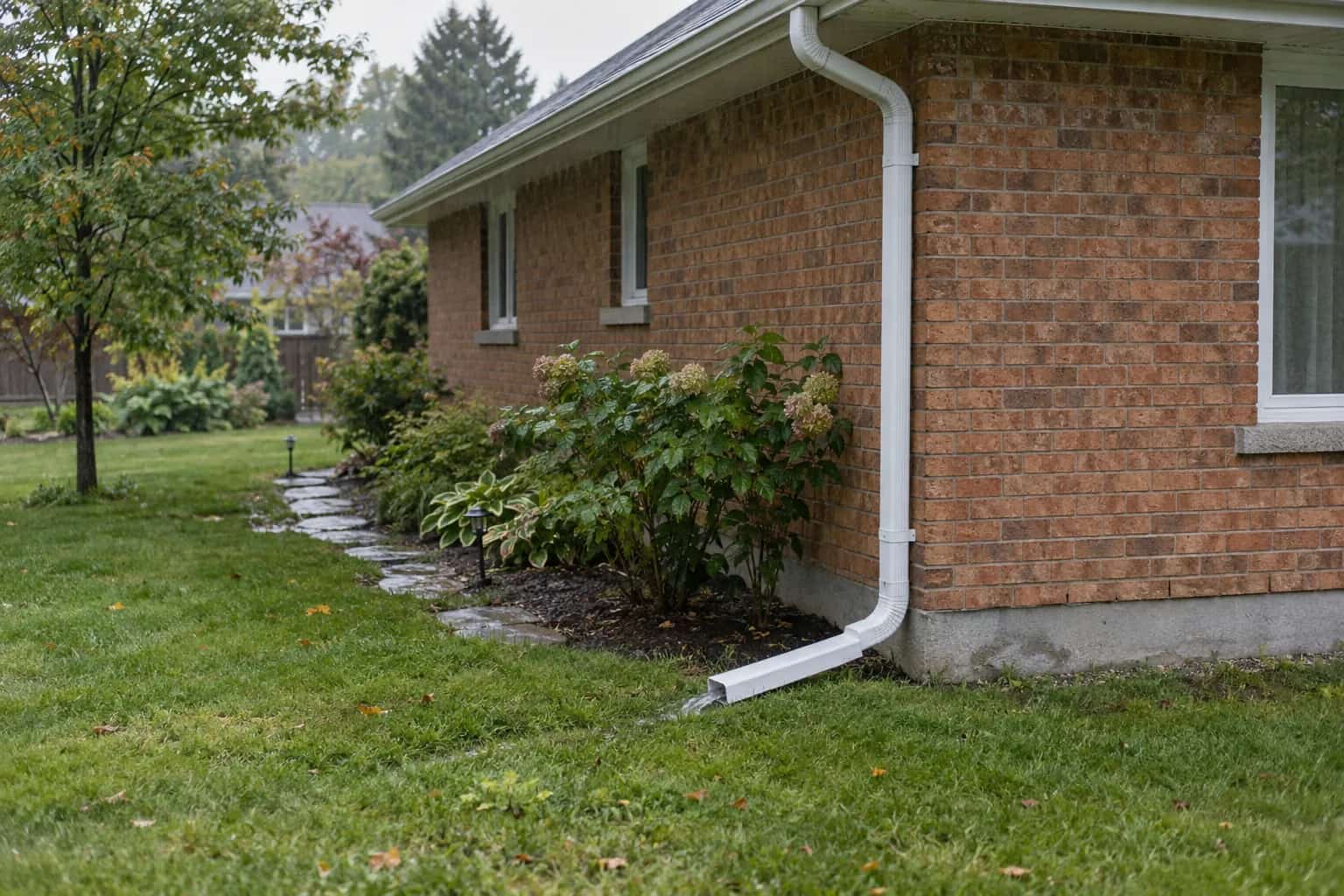
The splash pad was spotless. The soil beyond it had moved several inches downhill and was collecting against the path. Pat gave the pad a long look.
"Very clean."
"It has had plenty of washing," Dave said.
The first shopping idea was a bigger pad. We followed the little channel before choosing one. Otherwise, the next storm could simply begin its digging at the new far end.
Impact protection and a suitable drainage route are different things. The pad can soften the landing while concentrated runoff continues across vulnerable soil. Follow the channel to its destination before buying another piece of concrete.
Look Beyond the Clean Patch
Toronto's downspout-disconnection instructions include a splash pad to help prevent erosion at the outlet. That practical detail belongs within the complete discharge route. It is not a guarantee that any soil beyond the pad can receive unlimited concentrated flow.
Picture a newly seeded lawn beside a roof extension. Water lands on the pad, leaves through a narrow opening between two edging stones and crosses bare soil. The pad is doing one job; the stones have concentrated the next stage. Another scenario is a pad that has settled backwards, letting water collect toward the wall before escaping sideways.
Those observations lead to different corrections. Do not assume every washed strip means the same product failed.
Find What Is Moving
After safe access returns, photograph the pad, the beginning of the channel and the area where sediment collects. Include a ruler beside a small surface feature only if this can be done without entering unstable or wet ground; exact measurements are less important than a clear location and comparison over time.
Look for displaced stones, exposed roots, a sunken pad or soil accumulating against a path. A widening channel may redirect later storms more strongly along the same route. If erosion affects a slope, retaining wall, foundation or buried service, keep clear and obtain appropriate assessment.
Do not fill the channel repeatedly without understanding the source. Fresh loose soil may simply become the next sediment deposit farther downhill. Also avoid washing the material into a catch basin as part of cleanup.
The Erosion Can Move Downstream
Protecting impact does not necessarily stabilise the continuing flow.
Landing point
A splash pad reduces direct impact at the pipe outlet.
Concentrated exit
A narrow gap can gather that water into a smaller stream.
Exposed soil
The continuing flow may remove unprotected material.
Receiving area
The correction must remain stable beyond the protected patch.
Match the Correction to the Route
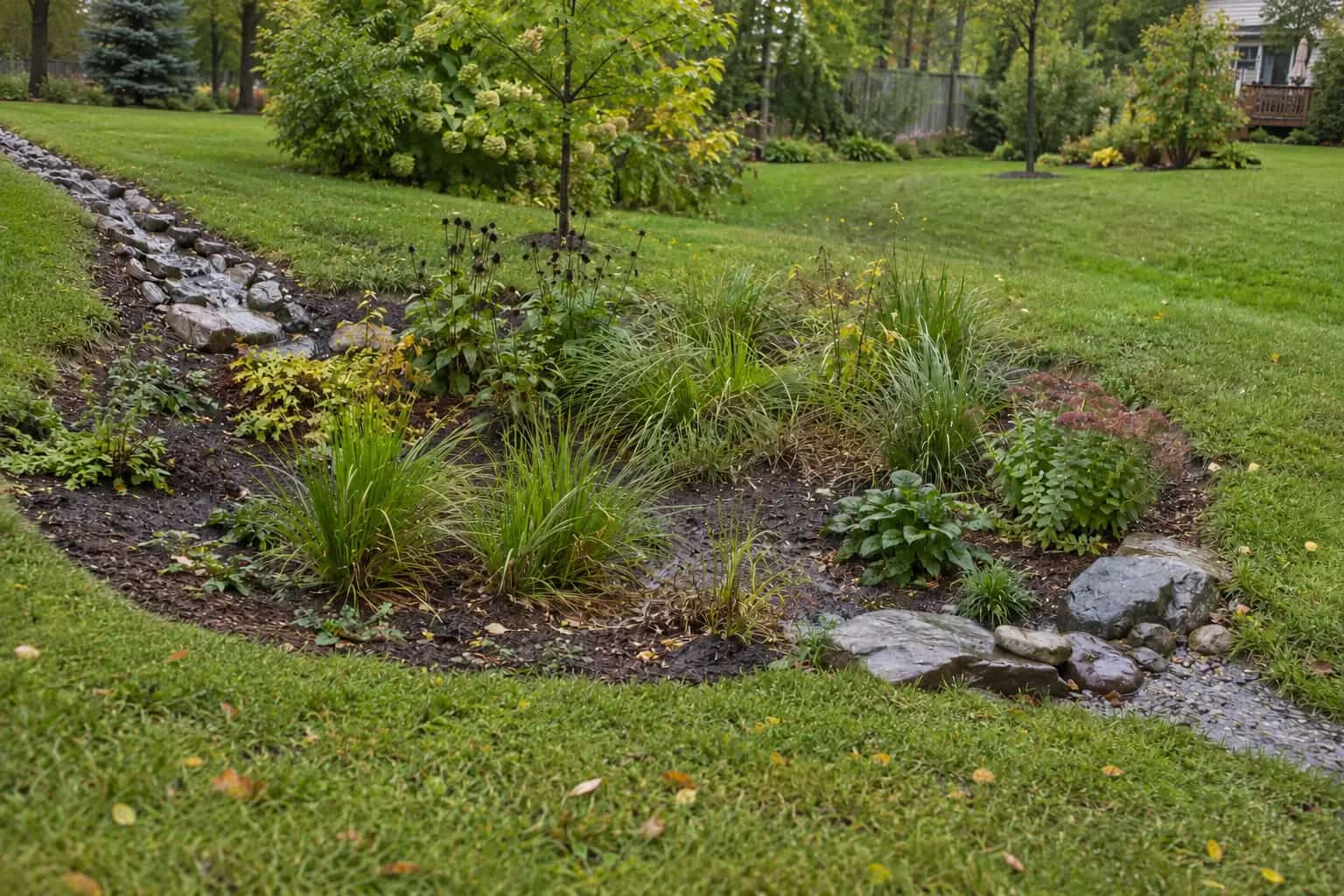
A drainage or landscape professional may consider stable outlet protection, a broader suitable receiving area, adjustment of grade or a revised discharge location. The choice depends on the flow and site, not just which decorative stone looks best beside the house.
Ask what keeps water from concentrating again immediately after the treated patch. A long narrow stone strip can still carry water toward an unsuitable destination. Conversely, spreading water over an area that slopes back toward the house is not an improvement.
Pickering's lot-drainage illustration shows roof discharge in relation to the slope and swale. The useful principle is the connection between components. Its drawing is not a substitute for measuring the actual receiving levels on your property.
Where the soil remains wet rather than washing away, use the persistent lawn-wetness guide. Low absorption and erosion can coexist, but they are not the same observation.
Two decorative stones narrowed the exit from the pad. They looked harmless in dry weather, which is when almost every garden decision gets made. We included them in the flow photograph instead of cropping them out to show only the muddy bit. The correction needed to explain the concentration, not merely cover the evidence.
Protect the Route During Landscaping
If the problem began after a bed was rebuilt, show the landscaper the roof area feeding the outlet and the old flow path. Keep exposed soil and stockpiles out of that route while work proceeds. A new plant is not immediate erosion protection merely because its tag promises a large mature size.
Agree who maintains the area until the chosen surface is established and what rain damage triggers a return visit. Keep the outlet accessible rather than hiding it completely behind the new planting. You need to see whether the correction works.
For a route leading toward a ravine, the ravine-runoff guide covers the additional site constraints. Do not extend a small yard repair into an uncontrolled discharge down a steep bank.
Check Both Ends of the Improvement
After appropriate rain, compare the landing point and the final receiving area. Has the original channel stopped growing? Is sediment now collecting somewhere else? Is any water returning toward the wall?
Keep those observations with the work record. A corrected outlet should protect the surface and preserve a suitable water path. The success measure is not that the pad looks larger; it is that the next section of yard is no longer being excavated one storm at a time.
We kept the before photograph of the downstream sediment, not just the pad. If that deposit moved farther along after the work, the garden would be telling us the job was unfinished.