
The upstairs bedroom is cold; downstairs, somebody has opened a window because the living room is too warm. "More heat" has already lost the household vote. A cold room can lose too much heat, receive too little, or have both problems. Start by separating those questions before ordering attic insulation or a larger furnace.
Start by separating heat loss from heat delivery. Then locate the cold part of the room. A floor over an unheated garage, a short wall against a side attic and a room at the end of a heating branch present different questions.
Describe the Room, Not Just the Thermostat
Compare the room temperature with a nearby comfortable room at similar times, away from direct sun and supply outlets. Note where discomfort is strongest: the floor, a window, a sloping ceiling or the whole room. Include whether wind changes it and whether the problem has always existed or followed a renovation.
For a forced-air system, check that furniture and rugs are not covering room grilles. Mention whether the bedroom door is normally open or closed. These are observations for the heating assessment, not instructions to rebalance the whole house by shutting vents elsewhere.
A room that is uncomfortable only under one condition gives a more useful clue than a complaint that the furnace is bad. You do not need a week of measurements before arranging help, but a comparison is better than two people arguing about whether 20 degrees feels warm.
The bedroom supply grille is partly behind a dresser. Dave asks to see the ordinary furniture arrangement, not a tidied room prepared for inspection. The family moves the dresser for the assessment but keeps investigating. One obstructed grille is a useful finding; it is not permission to stop looking at the rest of the room.
Follow the Boundary Around the Room
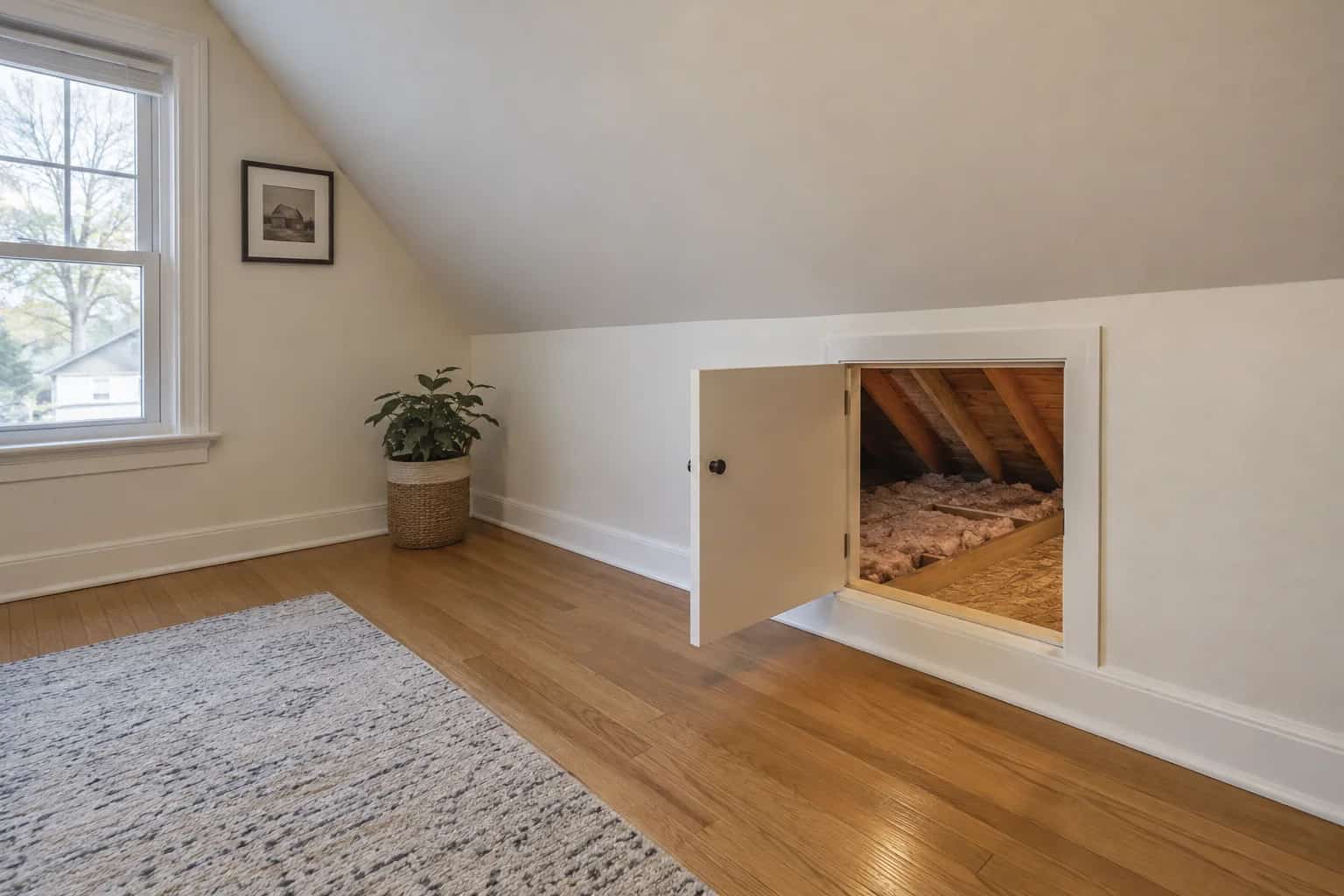
Mike walks the room rather than looking only upward. The garage below, the short wall beside a triangular attic and the sloping ceiling all belong in the assessment. The homeowner had imagined one patch of missing insulation overhead. The room has more than one boundary capable of losing heat.
NRCan's guidance on attached garages and additions addresses insulation and air sealing where living space meets a garage. That separation also limits garage pollutants entering the house. Do not cut transfer openings or borrow garage air as a comfort remedy.
At a side attic, the wall, floor connection and sloped ceiling need to form a coherent boundary. The knee-wall guide explains that junction in detail. A photograph of thick insulation somewhere in the attic does not prove the cold bedroom's boundaries are complete.
A water line in the same cold cavity needs a separate freeze-risk and pipe-route review.
Three Investigations for One Cold Room
The same complaint can lead to different work, and more than one finding may apply.
Cold floor or boundary
Inspect the actual separation from a garage, side attic or outdoors.
Wind-sensitive discomfort
Investigate air routes and continuity of the enclosure.
Weak heat delivery
Check the room's heating supply, distribution and operating conditions.
Combined finding
Coordinate enclosure and heating work where both contribute.
Is Enough Heat Reaching the Room?
An HVAC assessment should look at delivery as well as the heating appliance. In a ducted system, restricted or disconnected ductwork, airflow and the route for air to return deserve attention. CMHC's furnace-and-boiler guidance includes ductwork and airflow checks rather than assuming the appliance alone explains poor performance.
Warm air at a grille is not the same as enough heat reaching the room over time. The contractor may need to compare the room's heat requirement with measured delivery and the system's operation. A radiator or electric baseboard room needs the equivalent equipment-specific assessment; duct advice does not apply to it.
NRCan recommends following equipment maintenance requirements. A larger furnace should not be the first answer to one cold room without checking the distribution and heat-loss conditions.
Later, the owner produces a thermal photograph with a dramatic cold stripe. Mike asks where it is, what the weather was doing and what construction lies there. "Good clue," he says. "Still needs a sentence explaining it." The picture goes into the file with observations instead of becoming the diagnosis by itself.

Use Diagnostic Tools to Narrow the Repair
A thermal image shows a surface-temperature pattern, not a photograph through the wall. NRCan describes infrared scanning alongside blower-door testing as a way to help locate air leaks and missing insulation. A cold area still needs to be related to construction, weather and air movement. An energy evaluation can help connect enclosure findings with the house's heating needs.
By the proposal stage, the family needs a repair they can point to: an identified floor-cavity air route, missing insulation at the slope, a duct defect, or a combination. Mike sends "add insulation upstairs" back for detail. Upstairs is a location, not a diagnosis.
Compare comfort again under similar conditions after the work. The aim is a bedroom that receives and retains the heat it needs, without overheating the rest of the house to compensate.