
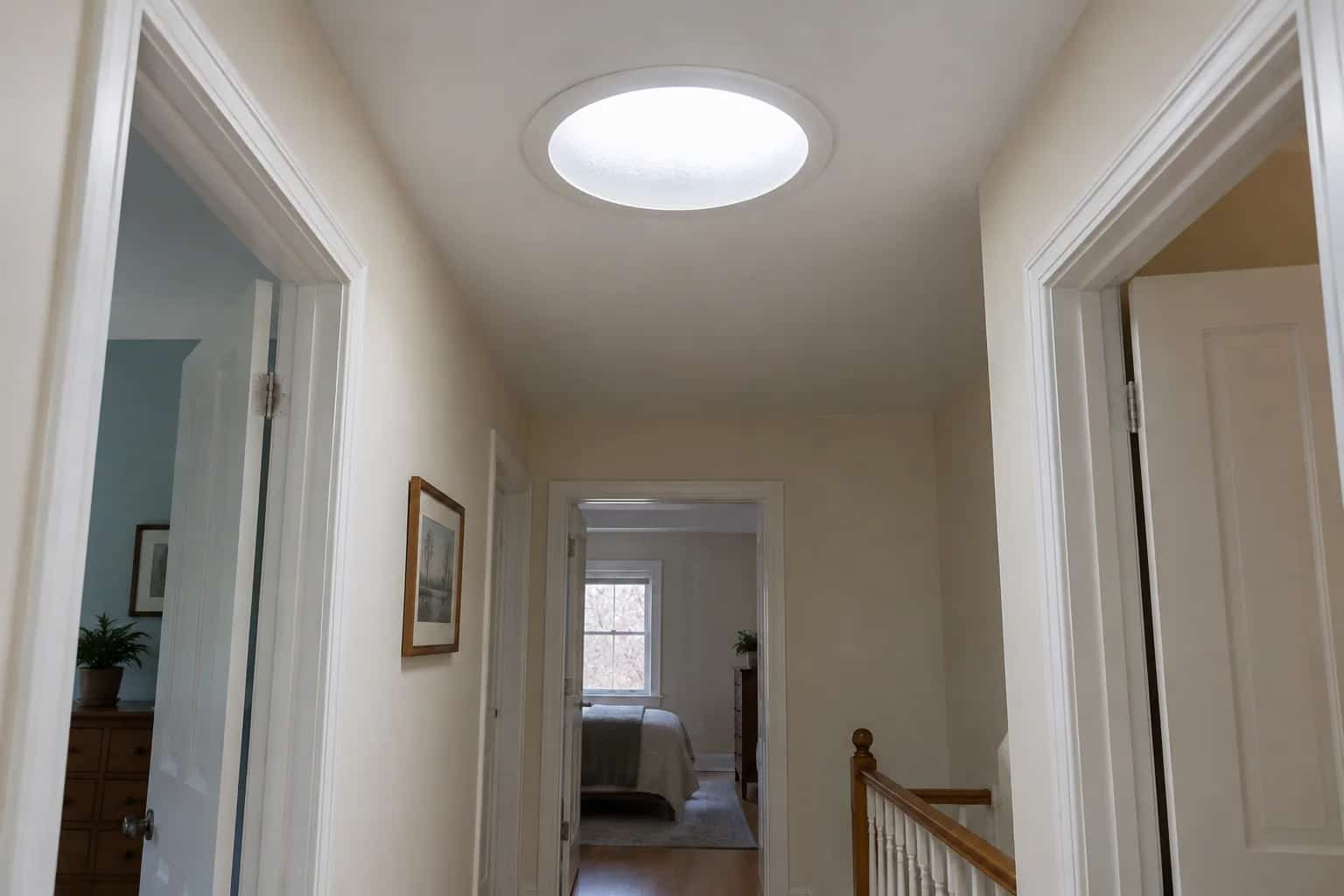
The hallway is bright in the installer's summer photograph. Your question concerns finding the school shoes at eight on a grey January morning. A room-area recommendation is a starting point, not a guarantee for that hour and task. Tell the designer when and where the light must be useful.
Mike puts a cross on the hallway plan where the missing shoes usually live. "Here, at breakfast time," is a workable brief. "Somewhere brighter" is going to produce a much less interesting answer.
A sun tunnel can make a dark interior space much more pleasant. It cannot deliver daylight before daylight exists, and its winter output should not be guessed from a clear midsummer noon. Keep dependable electric lighting for early mornings, evenings and darker weather.
Name the task instead of only the square footage
Write down the room dimensions, but add the places that matter: bottom stair, wardrobe shelf, hallway turn or bathroom basin. Mark furniture and doors that can block light travelling across the room.
A narrow corridor and a square room can have the same floor area while needing different distribution. A diffuser over one end of the corridor may brighten that end beautifully and leave the turn in shadow. More light directly below the opening does not necessarily solve the actual inconvenience. Mike keeps the cross at the dark turn instead of moving it to the easiest place to install the diffuser.
For example, a household may want enough daylight to move comfortably through a central hall, while still using an electric task light to read labels in a cupboard. That is a realistic design brief. "Replace all the lights" is a much larger promise with very little information behind it.
Put the collector and diffuser on different drawings
The roof collector needs a location; the ceiling diffuser needs one too. Connecting those points may require a longer or bent route through the roof space. Ask the installer to show both ends and the proposed path rather than only pointing at the ceiling.
VELUX's Canadian FAQ identifies orientation, tunnel length, angles, time and season as factors in light delivery. Its broad room-size suggestions should be read alongside those conditions. They are not a winter illuminance prediction for a shaded Ontario house.
Identify nearby trees, taller roofs and chimneys that could shade the collector at the relevant season. A leafless deciduous tree may change the exposure differently from an evergreen or a neighbouring building. Ask how the actual winter sky view was considered, not just whether the collector faces a favourable compass direction.
Ask what evidence supports the promised result
A useful proposal states the exact product and size, tube type, approximate route length, bends and diffuser location. If it promises a particular light level, ask for the calculation or simulation and its assumptions: weather/sky condition, date or season, time and measurement point.
The VELUX daylight-design reference explains why sky conditions, geometry and surface properties affect daylight performance. A model can be useful when its inputs describe your room. A beautiful rendering with no stated conditions is mainly a picture of a beautiful rendering. The shoes remain unimpressed.
A comparable installed room can help judge the experience, provided you know its route and the conditions during the visit. Do not compare a short straight tube on a sunny roof with your longer route behind an obstruction and assume the same result.
Turn winter expectations into a brief
A useful estimate connects a room task to a specified daylight route.
Occupied location
Mark the stair, cupboard or corridor turn that needs light.
Winter exposure
Assess the collector's sky view and seasonal obstructions.
Tube route
Name the product, length, bends and diffuser position.
Evidence and backup
Review stated design conditions and retain electric light for dark hours.
Choose the improvement you would notice
If the problem is a dark turn in the hallway, compare moving the diffuser with increasing its size. If two separated locations need light, compare distribution options rather than simply enlarging one bright patch. Structural and service constraints may limit the available routes.
The sun-tunnel-versus-skylight guide covers the larger product choice. For a sleeping room, settle daylight control at the same time; winter may be the dimmest concern, but summer arrives with an earlier alarm clock.
Keep the final layout and product details. After installation, judge the result at the locations and times you named in the brief. That gives any follow-up conversation a concrete question: did the design improve the dark hallway turn, rather than merely create a very convincing bright circle on the ceiling?
