
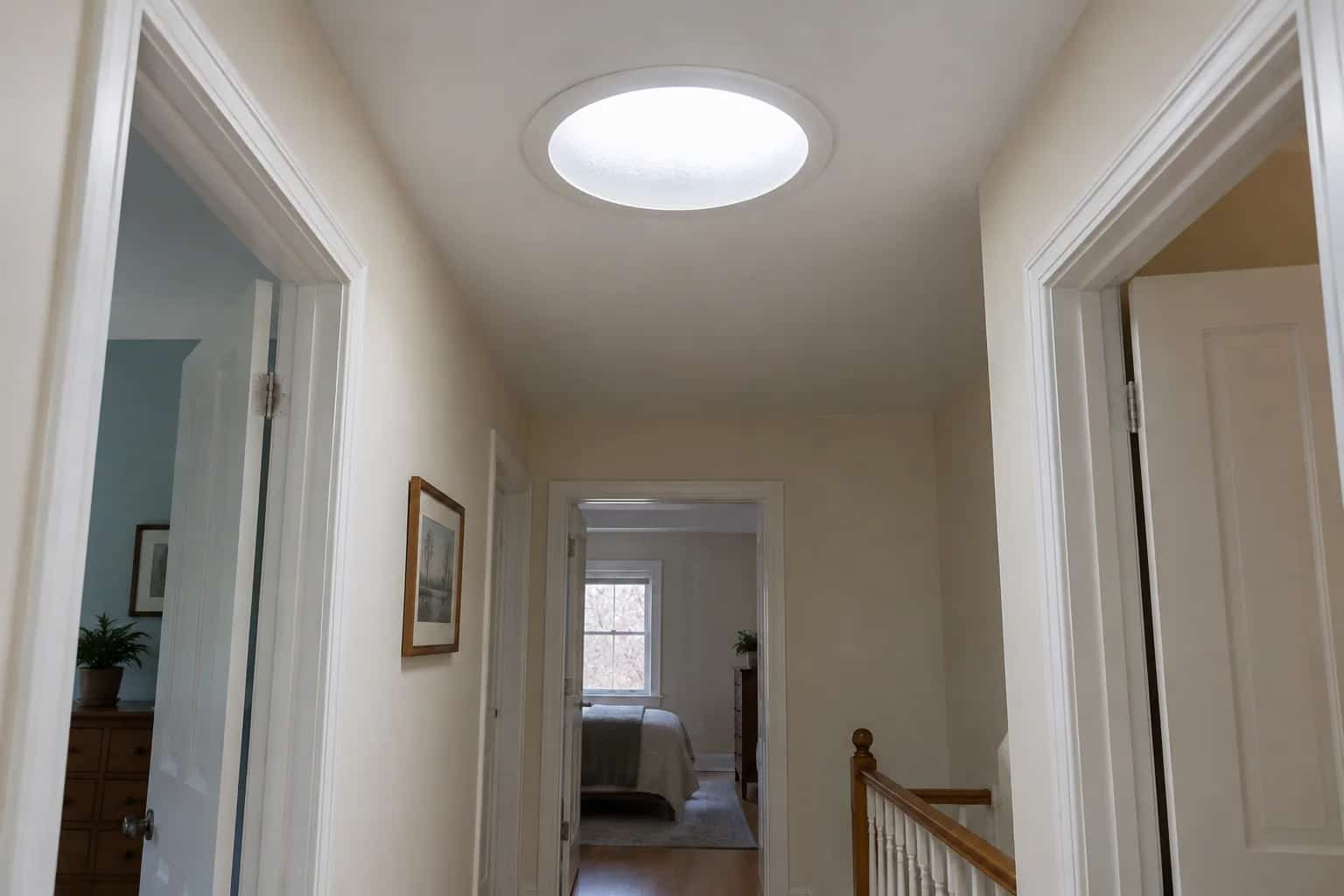
At noon the new sun tunnel is doing an excellent job. Unfortunately, noon is bedtime after a night shift. Light control should be confirmed for the exact tubular device before the bedroom is promised darkness. A round ceiling diffuser is not a conventional skylight with a blind waiting to be clipped into its frame.
The bedroom door closes after the night shift, the wall curtain closes, and the bright circle overhead carries on with its excellent morning. "We forgot that one," is an entirely fair description of the design meeting.
There may be a suitable accessory. VELUX Canada's sun-tunnel accessory page describes daylight-control options alongside other accessories. That establishes a question worth asking, not a universal answer for every tube diameter, model or installation year.
Begin with the device above the round trim
Record the manufacturer, model, size and any existing light kit. If paperwork is missing, ask the supplier what identifying photographs can be obtained safely from the room. Do not dismantle the diffuser or push a cover into the tube to search for a label.
The ceiling trim's outside diameter is not necessarily the product size used for ordering. Nor does a part advertised for a similar-looking tubular skylight establish compatibility. Older units and other brands may need a different solution or have no supported retrofit.
The ordinary skylight-identification steps show how to keep product codes and measurements separate. For a tube, make clear that the enquiry concerns the tubular daylight device rather than a rectangular glazed roof window.
Ask what the controller actually does
A daylight controller reduces admitted daylight. A decorative diffuser changes its appearance or distribution. An electric light kit adds light when daylight is unavailable. Those functions can be listed together in the same accessory catalogue while solving opposite problems. A night-light kit is particularly committed to the opposite problem.
Ask for the compatible controller's model, operating method and installation instructions. Then ask the question the sleeper actually cares about: how dark will the completed room become, including any light around the diffuser or other room openings?
Do not turn a phrase such as light control into an unsupported promise of total blackout. Request the manufacturer's stated performance and, where practical, see an installed example. A phone photograph automatically adjusting its exposure can make a dim room look bright, or the reverse. The camera is not the person trying to sleep.
Do not confuse the accessories
Similar-looking additions can change daylight, add electric light or only change its appearance.
Daylight controller
A compatible device regulates incoming daylight.
Decorative diffuser
Changes the ceiling finish or light distribution; confirm any reduction claim.
Light kit
Adds a light source when daylight is unavailable.
Room darkness
Includes the device, control operation and other room openings.
Compare two routines before choosing a control
For a guest room used occasionally, a supported manual solution may be workable if it can be reached safely and used as intended. For daily daytime sleep, a compatible control operated from the room may be much more convenient. Include what happens if its power source or control fails.
A control reached only by placing a ladder beside the bed is a poor daily routine. So is a removable cover whose storage place becomes the top of the wardrobe, just beyond reach when needed. We would settle that boring detail before debating trim colour. At the end of a night shift, climbing for a removable cover is unlikely to improve anyone's opinion of the renovation.
If an electric or solar night-light accessory is fitted, check how it operates independently. Blocking daylight while leaving another light source active may explain a room that still will not become dark.

Avoid the improvised plug
Tape, foil, foam or fabric stuffed into a diffuser assembly is not a manufacturer-approved control. The device can include glazing, seals, insulation-related details or electrical accessories that should remain serviceable and correctly assembled. Ask for a compatible method instead of experimenting overhead.
For a new bedroom installation, consider whether a conventional skylight with an appropriate shade better fits the light-control requirement. It brings different roof and interior work, so compare complete arrangements rather than just the accessory price.
For an existing tunnel without a suitable controller, have the installer explain the supported options, including alteration or replacement if necessary. Keep electric lighting available for normal room use. The aim is flexible daylight when wanted and dependable sleep conditions when it is not, rather than a beautifully bright room the occupant has to defeat every afternoon.