

The rear roof is easy enough to see and awkward to reach. A quote assumes access through the neighbour's gate; the neighbour assumes the path will stay clear for school mornings. Mike puts the timetable beside the site sketch. Both assumptions need an answer before the bin arrives.
The roof quote looks straightforward until someone asks where the ladder, delivery truck and waste bin will go. On a tightly spaced townhouse, those are construction decisions, not minor arrangements for the morning of the job. Walk the access route before fixing the start date, and resolve any reliance on neighbouring land.
Freehold ownership does not, by itself, authorise a contractor to use neighbouring land. Check the title information, applicable easements and local rules with the appropriate adviser when access is uncertain.
Draw Access and Storage as Separate Areas
The side-yard quote has one more assumption: bundles can sit beside the neighbour's gate for two days. The access route and storage area are different permissions. Mark them separately on a site sketch before agreeing to the price.
Include the gate width, ladder or scaffold footprint proposed by the contractor, waste route, overhead services, occupied doors and the place where materials will actually wait. Record the condition of surfaces and planting with permission before work. Keep the emergency contact and restoration arrangement with the written scope.
A friendly conversation is still worthwhile even where a legal entry route exists. The point is to make the work predictable for both households, including when the path will be clear again. For a property elsewhere in the GTA or Durham, ask that municipality which rule, consent or other process applies.
Toronto's Entry Rule Has Specific Limits
Checked October 15, 2026: Toronto Municipal Code Chapter 363, section 363-8.2 permits necessary entry for repairs or alterations only where the work cannot be done from the owner's property or an adjoining street. It requires reasonable written notice at least 24 hours beforehand, with prescribed information and service requirements; emergencies have a separate notice provision.
The power does not authorise entry into the neighbour's building, equipment or material storage, or vehicle parking. It also requires hazard prevention, restoration as far as practicable and compensation for damage. Read the full conditions before relying on it. This is Toronto's rule, not a general Ontario permission slip.
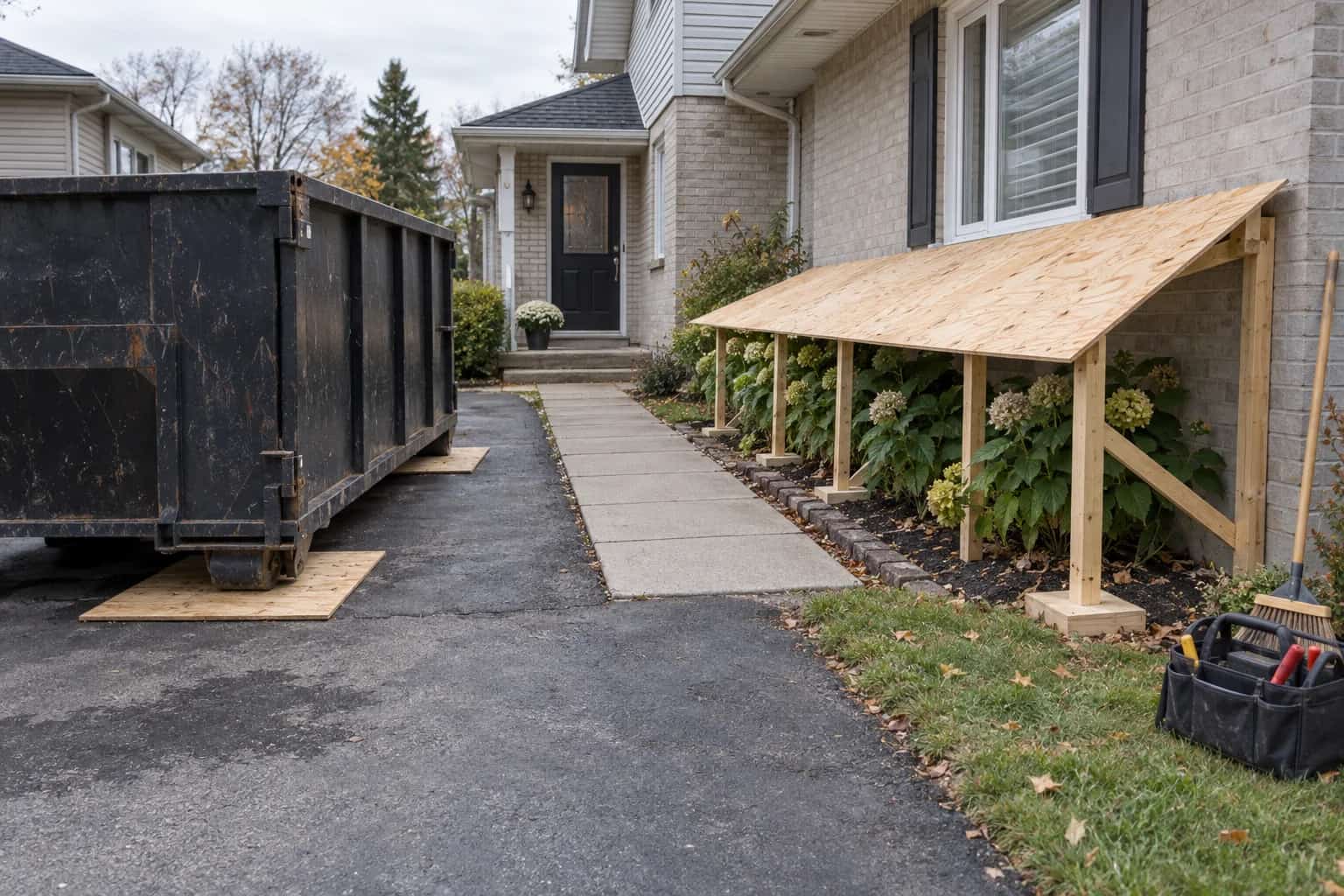
The Cheapest Quote May Assume the Most Space
One contractor may price a bin beside the house and direct delivery to the roof. Another may allow for smaller loads and a longer debris route. If only the second arrangement is physically possible, the first total is not a cheaper version of the same job.
Have each proposal state its access assumptions. Include what happens if the expected parking space is unavailable or a gate cannot be used. Resolving those details early can change the sequence or equipment without the pressure of a waiting crew and a truck blocking the lane.
Once the path and times are agreed, give the crew the same sketch the neighbour has. A separate plan kept only in somebody's head is how a reasonable arrangement turns into a surprise.
Access Is Not Storage
Map the route and why it is needed. Record protection, damage responsibility and completion condition.
Reach the work
Map the route and why it is needed.
Check authority
Use the applicable municipal process and required notice.
Place equipment
Distinguish temporary access from storage and parking.
Restore
Record protection, damage responsibility and completion condition.
Public Space and the Shared Roof Edge
Using a street or sidewalk may require separate municipal permission; a neighbour's agreement does not authorise public-space occupation. Have the contractor identify the permissions needed for the logistics shown on the sketch.
Then review the shared roof junction. Older, higher or different neighbouring roofing can change that detail. A visible seam is not proof of the legal property boundary. Resolve uncertainty before quantities are priced, and keep separate owners' payment and warranty responsibilities clear.
At completion, check the paving, fencing, planting and roof junction against the agreed record. Reaching the roof successfully should not leave the neighbour with a repair project.