
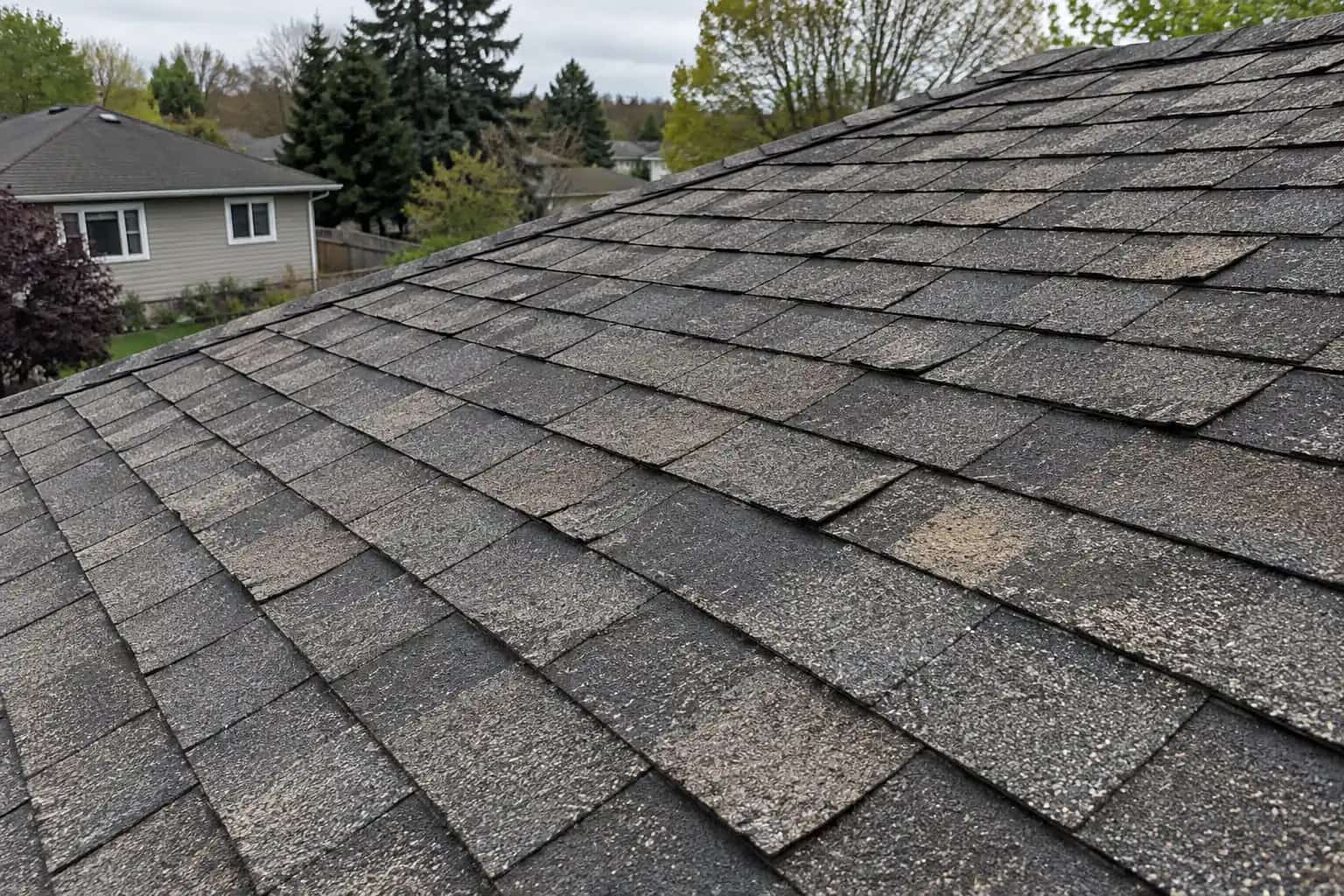
Low sunlight makes every shingle edge look dramatic. A broad hollow between support lines is a different matter. Before paying for a smoother-looking roof covering, establish whether the change is in the shingles, the decking beneath them or the framing that carries the roof.
Stay off a suspect area. If sudden movement, cracking sounds or falling material make you suspect structural failure, leave the building and call emergency services. Keep others clear while help is arranged. Walking over a dip to see whether it bounces is not a useful homeowner test.
An evening photograph makes the roof look alarmingly uneven. Chris asks whether thicker shingles will hide it. Mike asks for another safe ground view and the older listing photographs first. The covering might be creating the effect, or it might be showing a problem underneath. Buying camouflage is not the next step.
Record Shape Before Guessing Cause
Take photographs from more than one safe ground position. Include the whole roof line and fixed references such as a gable or chimney. Compare with older listing photographs if you have them. A long-standing shape and a recent change need different investigation, even when they look similar in one picture.
Chris also lists recent leaks, loading, impacts, roof work and attic alterations for the assessor. Mike keeps those as observations, not conclusions. A change noticed after an event belongs in the history; it does not by itself prove the event caused it.
Avoid drawing a conclusion from one telephoto image. Camera angle and perspective can make straight lines appear unusual, while roof coverings can hide changes underneath.
Which Layer Has Changed Shape?
The repair scope depends on the affected part of the assembly.
Shingle covering
Texture or local lifting may be limited to the roofing material.
Deck or sheathing
Deflection or deterioration can affect the surface spanning the supports.
Rafters or trusses
Support changes may require structural assessment and a designed correction.
New Shingles Cannot Straighten Damaged Supports
The covering, deck and framing perform different jobs:
- Shingles shed weather and have their own surface texture.
- Decking spans between supports and provides the base for the covering.
- Rafters or trusses carry the assembly.
A lifted shingle corner can be a local covering defect. A dip repeated between supports points the investigation beneath the covering. A changed ridge or displaced roof plane may involve a broader structural question. These are clues for assessment, not diagnoses from a distant photograph.
IKO explains that moisture-damaged sheathing can deform. Other causes remain possible, including support and installation conditions. Covering the shape with another layer may hide evidence while adding work that does not fix it.
Pat separates the layers on a sketch: covering, decking and supports. Chris had been using "roof" for all three. It is a useful word until someone offers to replace one layer as a cure for a problem in another.

When Structural Review Enters the Scope
If the concern involves rafters, trusses, altered supports or a wider change in roof shape, ask whether a structural engineer is needed. A roofer can identify a concern without being the person who designs its correction.
Do not accept casual cutting, bracing or jacking of trusses as an ordinary shingle repair. The repair must suit the actual structure, and any required approvals should be addressed before work. NRCan's attic guidance includes structural and moisture assessment before upgrades.
Let the Finding Set the Size of the Job
Local damaged decking can justify local replacement and correction of its moisture source. A framing problem needs an appropriate design before the roof is closed. A harmless visual effect does not need a structural repair.
This is the useful distinction to carry into a reroofing quote: what will the proposed work actually correct? Exposed-condition photographs and a clearly identified affected layer make the answer much easier to judge. A straighter finished picture is welcome, but the sound assembly beneath it is what you are paying for.
Dave leaves the structural question with the appropriate assessor rather than offering a quick brace from a photograph. Chris can now ask every proposed repair the same practical question: which finding does this correct? A smoother picture is welcome, but it is not the evidence we need before closing the roof.