
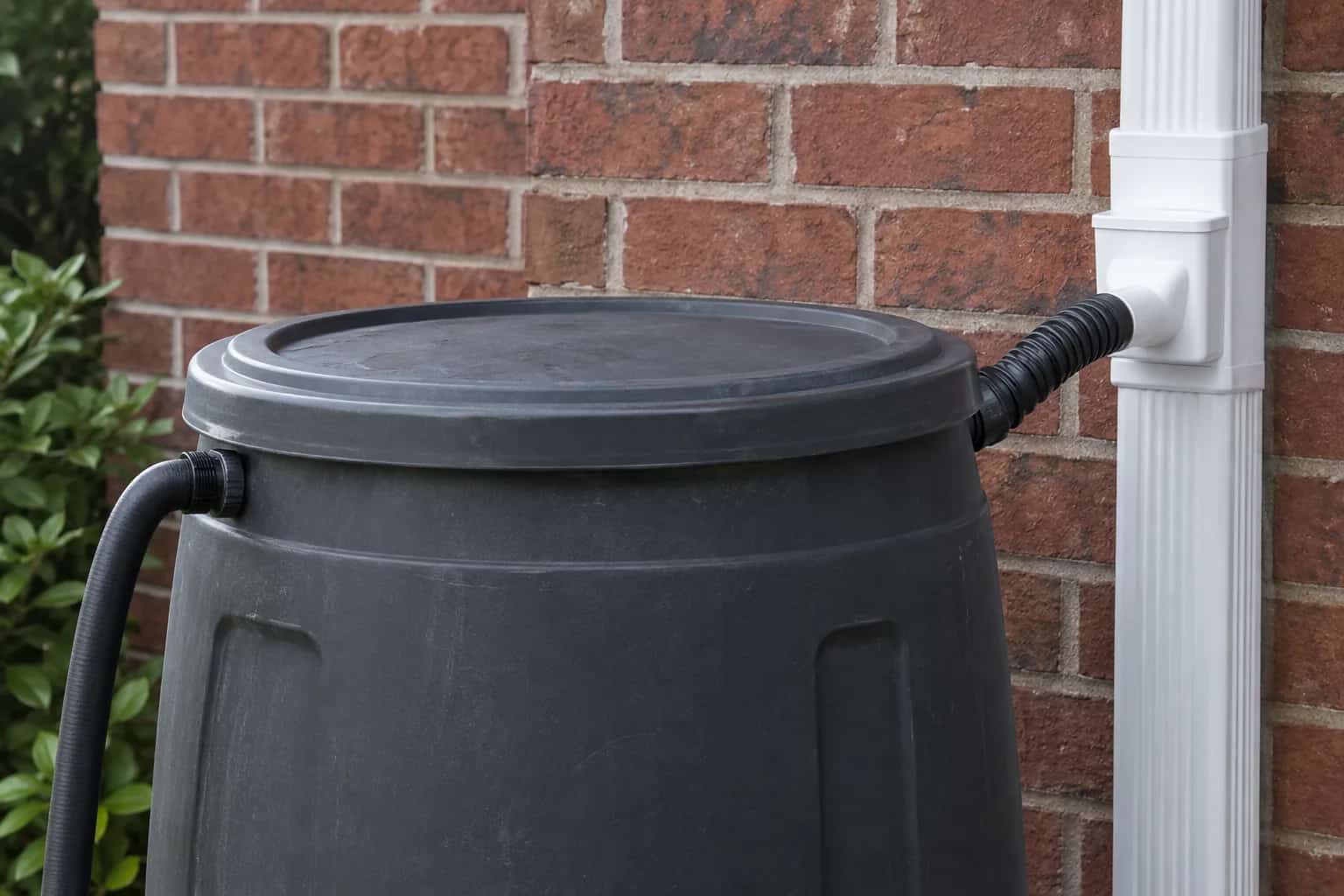
The barrel is full on Monday and empty on Wednesday. That does not necessarily mean you bought a bad barrel. It may mean the garden uses water faster than the available storage can bridge a dry spell. Compare supply, storage and demand separately before buying another container.
Mike would start beside the watering cans, not with the biggest barrel in the catalogue. What are you watering, how much do you actually use, and how often does rain refill the system?
At the back step, six pots and two watering cans provide a better starting point than the barrel catalogue. The owner says the barrel lasts hardly any time. Dave asks how many cans make one round. The answer is easy to observe and much harder to argue with than a general complaint about the weather.
Measure a Watering Round
For a few ordinary sessions, record how many known-volume cans you fill or otherwise measure the water used. Keep ornamental beds, pots and food crops separate. Plant type, weather, soil and the watering method affect demand; a general litres-per-garden rule can hide more than it reveals.
For a transparent example, imagine six ornamental containers receiving 5 litres each during one watering round. That round uses 30 litres. A barrel with 150 usable litres could supply five such rounds if there were no refill, other withdrawals or further losses. This is arithmetic, not a horticultural recommendation for how much those plants need.
The word usable matters. Water below the outlet, sediment and the practical way you draw from the barrel may reduce what you can actually use. The number moulded into the container describes capacity, not necessarily the water available for tomorrow's cans.
Dave can now answer the shopping question: another 150 usable litres adds five of those example rounds. It does not promise five rain-free days if the owner waters twice a day or starts using the barrel elsewhere.

Count Only the Roof Feeding That Downspout
Rain falling on the rear roof may reach a different outlet from rain on the front. Use the horizontal plan area contributing to the chosen downspout, rather than the whole house floor area or the sloping shingle area by habit.
As a unit conversion, 1 millimetre of rainfall over 1 square metre equals 1 litre of water before losses. So 10 millimetres over a 40-square-metre contributing area represents 400 litres arriving on that horizontal catchment. Not all of it necessarily reaches storage: wetting, leaks, bypass, diverter behaviour and overflow affect collection.
If the barrel in that example has only 150 litres of empty space, its extra storage cannot exceed that space regardless of the 400-litre theoretical roof input. A full barrel may receive rain beautifully while storing almost none of the next shower.
TRCA's rainwater-harvesting guidance places barrels at downspouts and treats collection, use and overflow as connected decisions. The calculation helps estimate potential; observation tells you how the installed arrangement behaves.
The arithmetic surprises the owner: another barrel adds a known number of these watering rounds, not an unlimited summer supply. Pat points at the pots added since last year. The collection system has not necessarily become worse; the garden has quietly acquired more customers.
A Monthly Rain Total Can Hide a Dry Fortnight
Imagine the same rain amount arriving in several small events or in one downpour followed by dry weather. The garden experiences different refill opportunities even if the monthly total is identical. Storage planning needs the sequence, not only the total.
Keep a short log of rain, the approximate fill level before and after it, and water drawn. You do not need laboratory precision. You need to see whether the main limit is a barrel that rarely fills, one that overflows while already full, or demand that empties it quickly.
If collection is poor despite an empty barrel, check the connected roof area and diverter before adding storage. If it fills readily but empties too quickly, reducing unnecessary demand or increasing suitable storage may be the relevant comparison.
Three Numbers to Compare
These are planning quantities, not promised collection or horticultural requirements.
Measured demand
Count the water used in a real watering round.
Potential roof supply
Multiply contributing horizontal area by rainfall depth, before losses.
Available storage
Count empty usable capacity at the start of the event.
Dry-spell coverage
Divide usable stored water by your measured round, without assuming a refill.
Keep the Water's Use and Overflow Clear
For food plants, consult the roof-runoff garden guide. A volume calculation says nothing about water quality. Ordinary screens and clear-looking water do not establish suitability for every use.
A larger or linked system also needs secure support, manufacturer-compatible connections and a dependable overflow. Toronto's guidance makes the receiving route and winter changeover important. Local requirements may differ elsewhere.
Before ordering another barrel, write down the expected extra usable litres and the number of your measured watering rounds that represents. That small calculation is more useful than a promise of free water all summer, particularly when August has other plans.
They keep the first barrel and record a few refill events before choosing another. Mike wants to know whether more empty space will actually be available when rain arrives. Buying capacity is simple. Using it between showers is the part that determines whether it helps.