
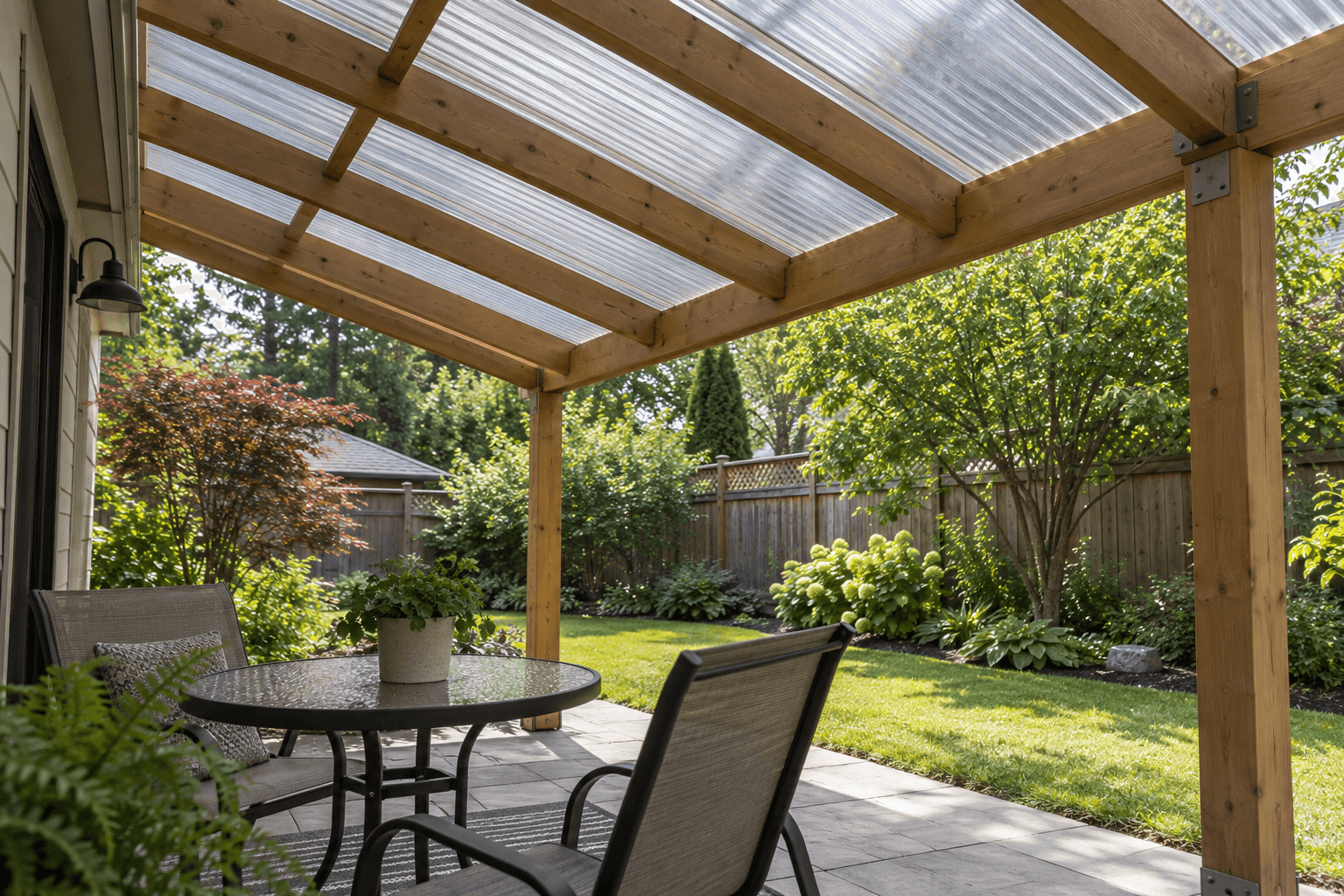
A translucent patio roof can shelter the table while keeping daylight near the house. The difficult part is choosing how much light you want, then making the selected panel work with the actual structure and weather.
Choose the panel, colour and supporting design together. Corrugated and multiwall polycarbonate products are different systems, and similar-looking sheets can have different span, fixing and accessory requirements. The cheapest sheet price does not describe the finished patio roof.
Start with the seat beneath the roof
Think about the hours when the patio is used. A sunny lunch spot, a shaded reading area and a covered route to the garden may call for different light levels. Also consider the kitchen or living-room window beneath the proposed covering.
Compare a useful-sized sample in daylight. Ask for the product's visible-light and solar-performance information for the chosen colour. A darker appearance does not by itself quantify how the whole patio will feel.
Palram's SUNTUF range includes different light-transmission choices. Use those product-specific figures when comparing its options, and obtain equivalent information for another brand. Do not choose a heavily shaded panel from a small indoor display and discover later that the adjoining room has become darker than intended.
From the chair to the roof detail
Start with use, then confirm the assembly.
Light below
Consider the patio and the adjoining indoor room.
Exact panel
Select profile, colour, thickness and matching accessories.
Design
Check slope, support, local loads and movement provisions.
Use and care
Keep drainage working and plan access without walking on sheets.
Identify the exact sheet and support arrangement
Write the product name, profile, thickness and length into the quote. Include the compatible closures, fasteners and wall or edge details. Corrugated profiles that look close may not fit the same closure strip.
The designer needs the roof projection, slope, support spacing and local wind and snow conditions. A sheet's light weight does not establish the load capacity of the patio. Snow arriving from an upper roof also belongs in that review.
Our patio-roof planning guide addresses the structure, attachment height and available headroom. Resolve those before ordering sheets to fit a frame that has already been built.
Palram's GRECA technical guide illustrates how profile, slope and support spans are connected. It is an Australian guide dated 2014, not an Ontario span table. Obtain current instructions for the product supplied here and have the local design checked.
Allow the panel to move as intended
Plastic roof sheets need their specified provision for temperature-related movement. Palram's technical FAQ explains why its SUNTUF instructions call for oversized fixing holes. The appropriate hole, washer and fixing method must come from the selected product's current instructions.
More tightening is not automatically a better seal. Ask the installer to show how movement is accommodated and how compatible washers and seals are specified. The GRECA guide also warns against overtightening and calls for approved accessories.
Confirm the UV-protected face where the product has a required orientation. Keep identification labels available until the installer has checked it. This is easier to establish before the panels are overhead.
Follow water to the outlet
The panel overlap and the house-wall junction are separate details. If the roof meets the house, ask how the wall drains onto the new covering, including at the ends. A surface bead along the siding does not explain the concealed connection.
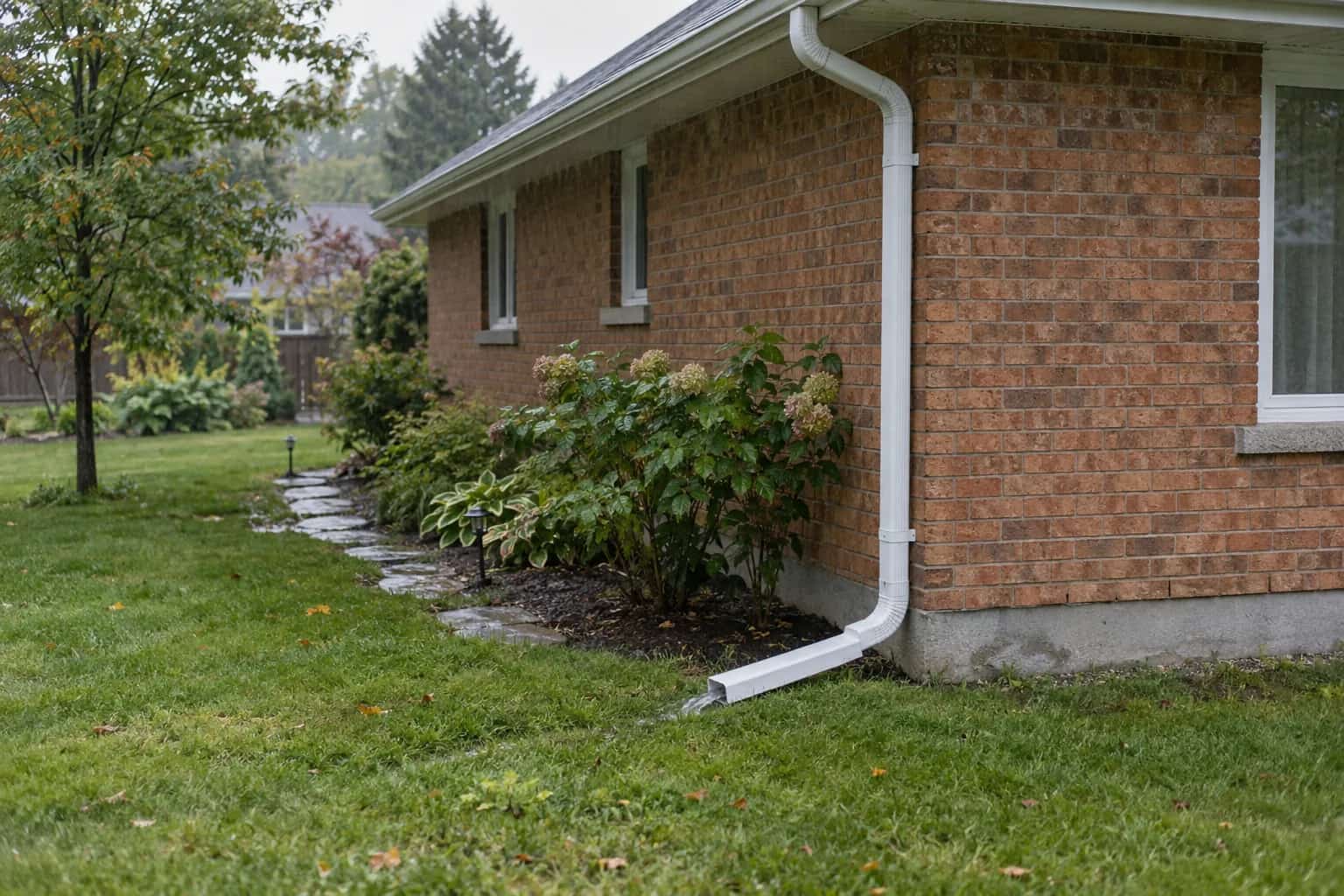
At the low edge, include the gutter and final discharge. Check the route past the patio door, steps and garden access. A dry table is less useful if the new outlet sends water across the route back indoors.
For an existing problem at that edge, see patio and roof-runoff planning. Keep a known drainage fault in the scope instead of assuming the new sheets will fix it.
Plan cleaning and future access
Ask how leaves can be removed and the surface cleaned using products approved for the panel. Household cleaners and sealants are not automatically compatible with polycarbonate.
Do not treat a translucent panel as a place to stand. Palram's guide prohibits stepping directly on its sheets; roof work needs an appropriate access method. Include future gutter and wall maintenance in the layout, especially where the new covering blocks the old ladder position.
Before accepting the job, keep the product labels, instructions and warranty with photographs of the finished edges and connections. The right panel should give you the light and shelter you wanted, with a service plan that does not depend on walking across it.