
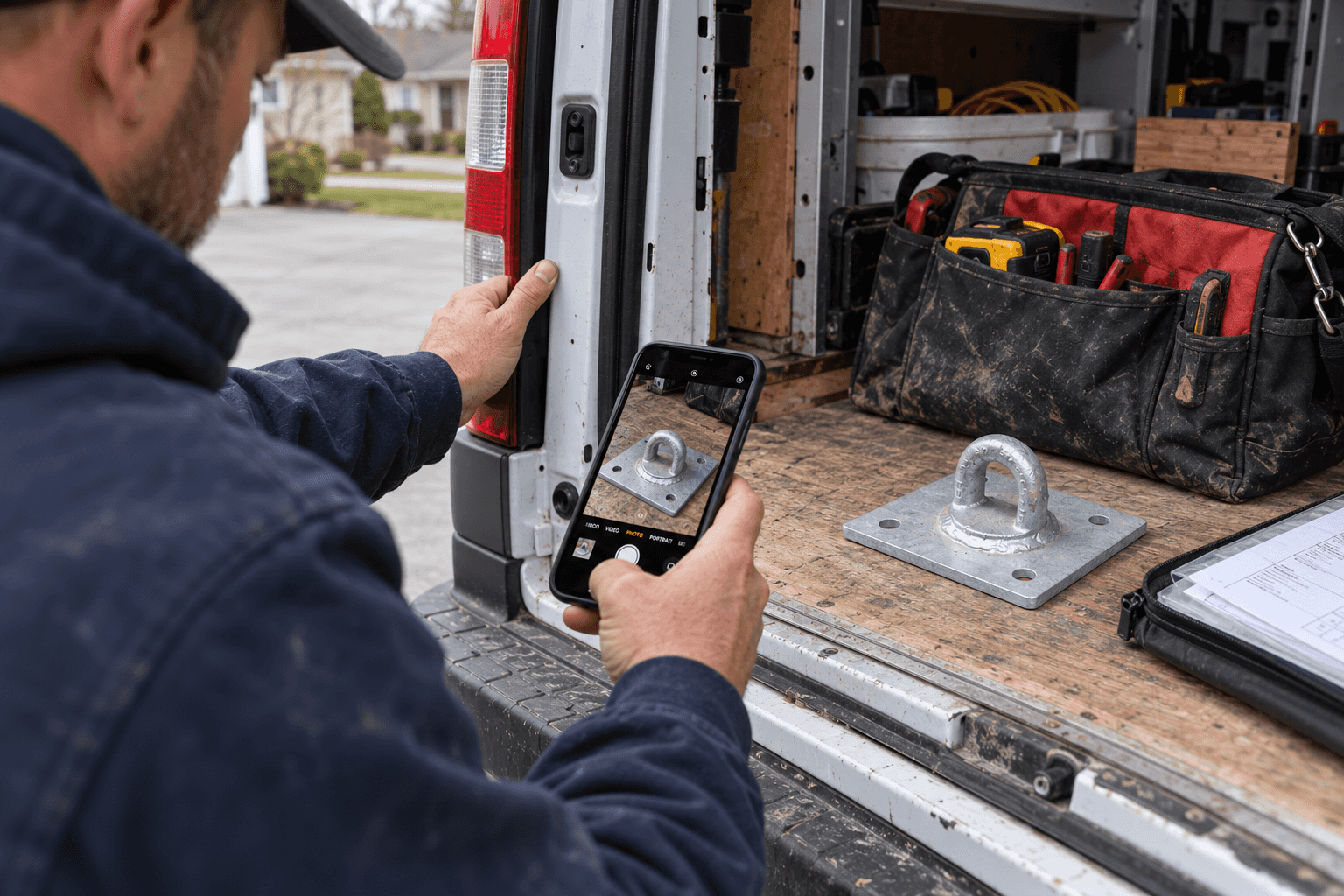
A contractor asks whether the roof has permanent anchors. You remember a metal loop near the ridge, but the installer left years ago and the paperwork is somewhere in a moving box. The useful next step is finding its identity and records, rather than promising that it is ready to use.
An anchor must be appropriate for the system, structure and work being planned. Its presence does not make roof access safe for a homeowner, and a photograph of the visible loop cannot establish the strength of its hidden attachment.
Establish what the fitting is
Ask for the manufacturer, model, intended use and installation documentation. A temporary roofing anchor left behind, an attachment for another purpose and a designed permanent anchor are different things. Appearance alone may not distinguish them.
CCOHS's anchor guidance explains that anchor performance depends on design, condition, load direction, connection and supporting structure. Have a competent person resolve those questions for the actual equipment and Ontario work requirements.
Do not use an unverified anchor or test it by pulling on it. Keep the roof visit with people who can plan the work and select the appropriate protection. The owner can supply records without taking responsibility for designing the contractor's system.
More than a visible loop
Keep these questions connected.
Equipment
Identify model, intended use and restrictions.
Attachment
Retain the installation and supporting-structure documentation.
Current condition
Keep inspection, repair and return-to-service records.
Actual work
Have the contractor plan access, protection and rescue for the task.
Ask about the whole access plan
The work may involve gutters, a chimney, solar equipment or an inspection on a different slope. An anchor in one location is not automatically useful for every task.
Travel restraint keeps a worker from reaching a fall edge; fall arrest is designed to stop a fall after it begins. The anchor and complete system must suit the intended use. CCOHS says permanent anchors intended only for travel restraint should be marked accordingly. Do not assume a restraint-only fitting is suitable for fall arrest because a connector fits its loop.
CCOHS's fall-protection planning guidance treats the plan as site-specific, including access, hazards, equipment, fall clearance and rescue arrangements. Ask the contractor to confirm how the work will be carried out, including getting onto and off the roof. A harness and a convenient loop do not answer all of those questions.
If recurring service is expected, discuss the work locations before deciding whether a permanent system would help. A qualified designer or contractor can compare appropriate access and protection options. Buying a fitting first makes the hardware drive a decision that should begin with the task.
Find the inspection history
CCOHS recommends inspection of permanent anchors by a competent person at least annually or according to the manufacturer's instructions, with records of inspections and repairs. That periodic report does not replace the worker's inspection before connecting. After a fall, CCOHS calls for testing by the manufacturer or a professional engineer competent in fall-protection systems. Do not return the anchor to use on the strength of an ordinary visual check. Have the responsible specialist establish the actual requirements for this system and jurisdiction.
Request the latest signed report, the next required action and any restrictions. "Inspected" is incomplete if the report identifies a defect that was never resolved. Keep evidence of completed repairs or recertification with the original finding.
If the history is unknown, say so plainly when arranging work. The contractor needs to address that uncertainty before relying on the anchor. An old invoice proves a purchase, not its present suitability.

Coordinate anchor work with reroofing
Show the roofer the anchor locations and records during planning. Ask who decides whether the anchors can remain, need removal for access or require replacement. Include the fall-protection specialist where the design or attachment will change.
A new covering, repaired deck or altered roof height can affect how the attachment and flashing are detailed. Require an agreed sequence for structural attachment and weatherproofing. Do not let one trade move or conceal a fitting before the other has checked the relevant work.
Photograph accessible details at the appropriate construction stage and keep the product-specific installation record. A finished close-up of the loop is useful for location, but it cannot replace documentation of the attachment beneath it.
Keep a short, usable record
Your roof folder should identify each anchor, its location, purpose, installation documents, inspection history and responsible service contact. Record any anchor taken out of service so it is not casually reused at the next visit.
For ordinary owner observations, the maintenance plan without ladders remains a practical approach. A permanent anchor is equipment for a properly planned job, not a new reason to climb onto the roof yourself.