The two quotes disagree about the valley, and neither includes a sketch. Pat draws the two roof slopes meeting, then asks each bidder to finish the water route. That quickly produces a better conversation than "metal is better" versus "we always close them".
Two slopes feed the valley, but its lower end may have only a narrow place to discharge. Choose the valley detail around that water route and the shingle instructions, then consider the appearance. Visible metal versus hidden metal is not the whole comparison.
Identify Three Patterns Without Guessing the Hidden Layers
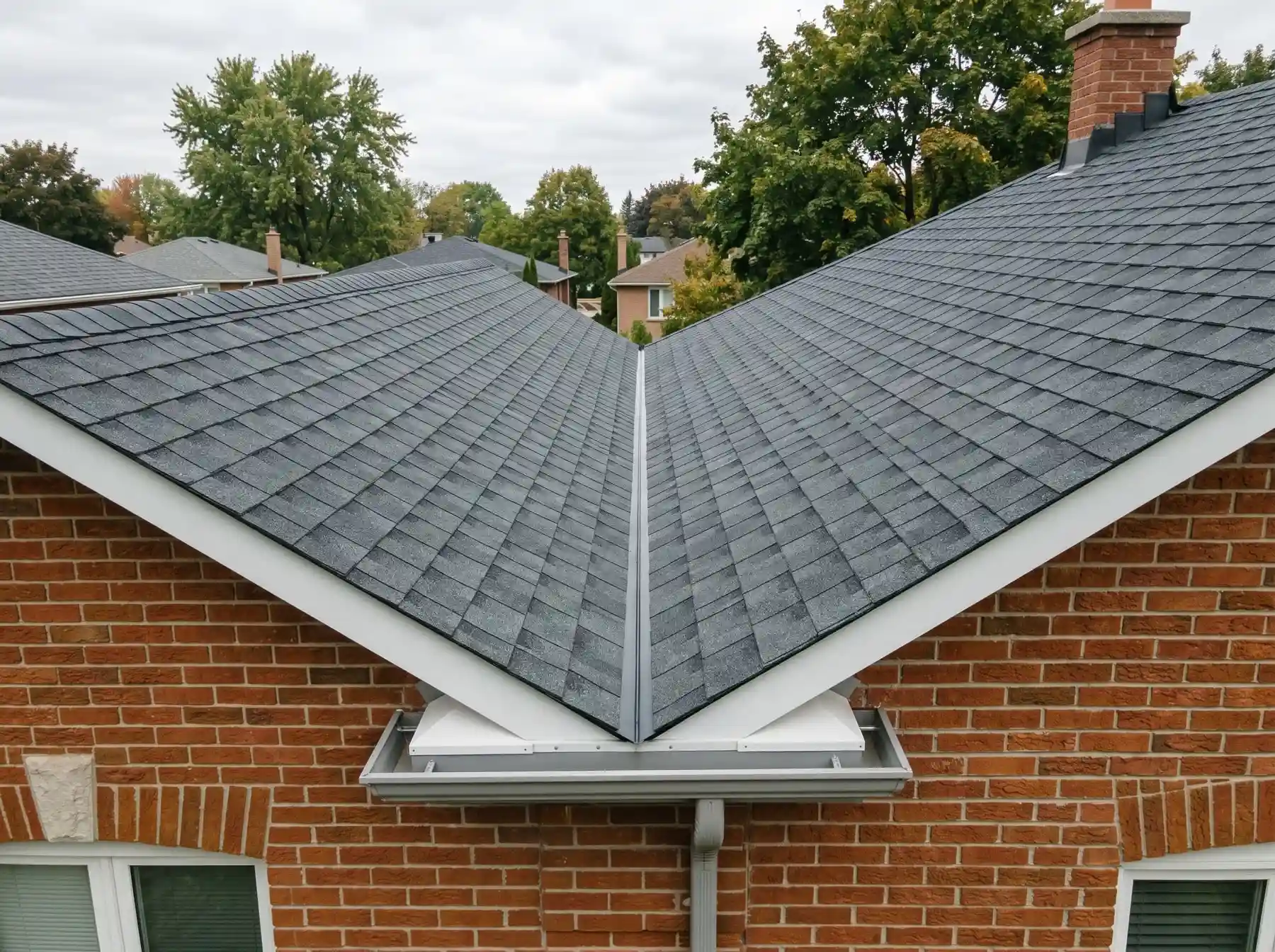
Open metal: a visible metal channel runs between trimmed shingle edges. Closed-cut: shingles from one slope cross beneath the other, whose visible edge forms a cut line. Woven: shingles interlace across the junction instead of making a separate exposed metal channel or one cut line. Those are surface identities; each still needs the required concealed protection and fastening detail.
IKO's valley guide explains the three forms, and its architectural-shingle guidance recommends an open valley for its architectural shingles. That is manufacturer guidance, not proof that every shingle accepts every closed or woven arrangement. Obtain the detail for the actual product.
Pat's sketch also shows a narrow valley receiving one large roof plane and one small dormer slope. Water does not arrive evenly from both sides. Ask how the selected detail accommodates that geometry and where the combined stream lands at the bottom. Keep this outlet discussion in the same drawing as the valley, including any nearby wall or gutter.
For a quote comparison, mark the valley type, lining material, product acceptance and lower termination. If a contractor proposes to retain old metal, ask how its condition and compatibility were assessed. Choosing an open valley for easier visible inspection still leaves the concealed connections to be installed correctly.
Compare Maintenance and Repair Access
An open metal channel makes some debris and surface conditions easier to see from a suitable vantage point. It still has concealed laps, attachments and underlying layers. Visible metal is not proof of perfect construction.
A closed valley may offer the appearance a homeowner wants, but repairs can require opening shingles along the junction. Aging, brittle shingles can make that work more extensive than expected.
Whichever method is chosen, avoid roof access to clear the valley yourself. A valley can be slippery, and careless tools can damage its surface. Arrange safe clearing and inspection where needed.
Leave the bottom of Pat's sketch visible while comparing the middle. Whichever covering you choose, the collected water still has to get past that last junction.
Keep the product-specific lining, fastening and lower termination on the written scope. Pat's finished sketch should let you follow the same water route that the installer is building, including how debris can be cleared later.
Same Valley, Different Exposed Surface
Both roof planes feed the valley. An open valley leaves a metal channel visible; a closed-cut valley carries water over shingles, with a cut edge beside the valley centre. These plan views explain the covering difference. They omit the underlayers, laps, cut offsets and fasteners that must follow the selected roof system.
Conceptual drawing. Product details, dimensions and attachment requirements are not shown.