
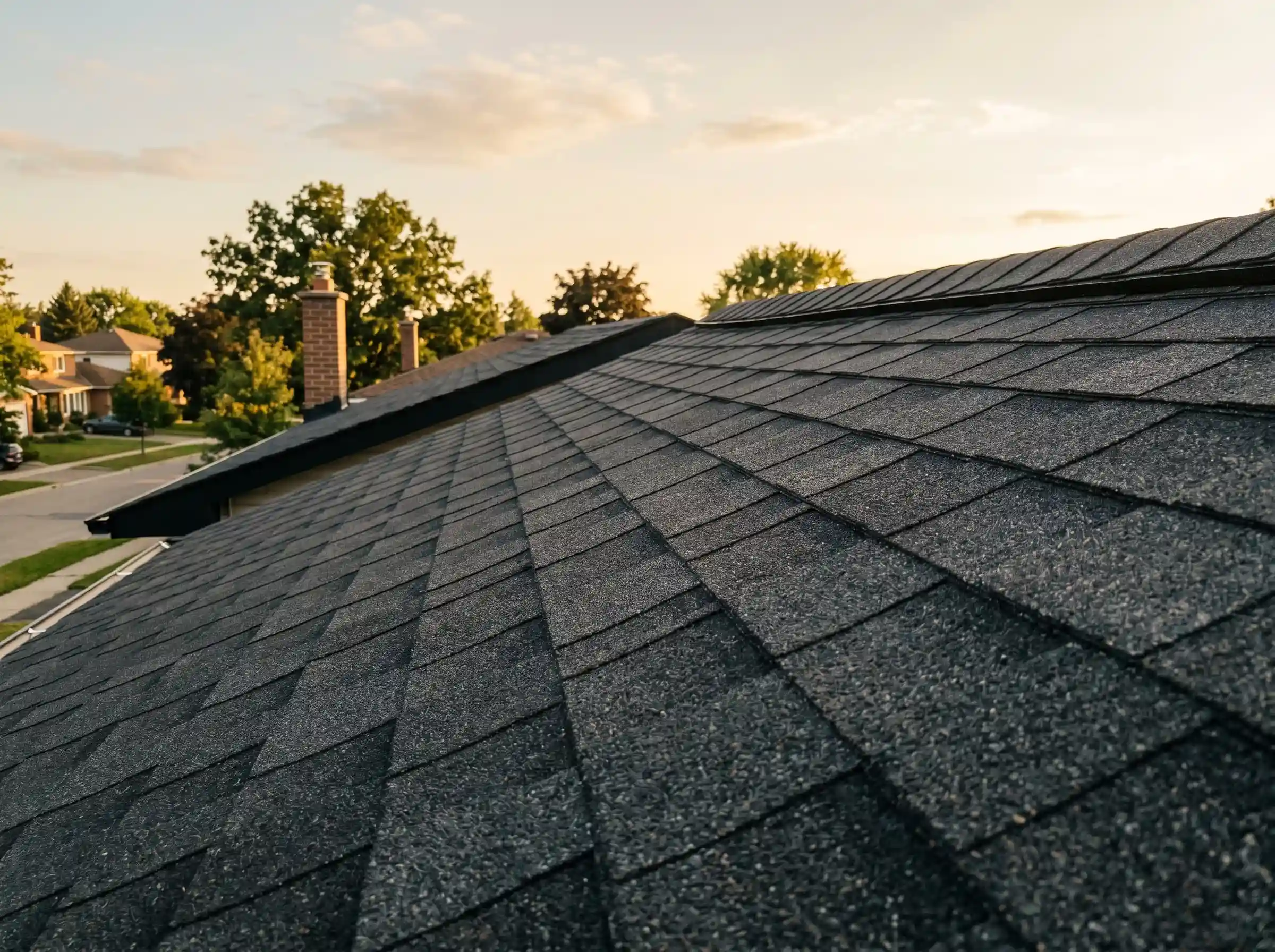
The roof looks even at lunchtime. At sunset, a dark rectangle appears above the garage, precisely where the owner will now look every time she comes home.
Pat asks for the same view on an overcast day, then asks about the wrappers from the leftover bundle.
"The rubbish?"
"The useful rubbish."
First separate a change in light from a pattern fixed in the material or installation. Comparable dry-roof photographs and the actual product information make the callback more useful than arguing about whether grey should look that grey.
Change the View Before Changing the Roof
Take photographs from the same safe ground position on a bright day and an overcast day. Add one from a different angle. Record whether the patch remains in exactly the same location and whether it has sharp boundaries.
IKO explains in its technical FAQ that granule embedment and reflection can produce apparent shading. That explanation is a reason to compare views, not a reason to dismiss every concern as normal.
Avoid judging a damp roof against a dry patch. Shade, moisture and nearby trees can change what the camera records. A phone's automatic exposure may exaggerate the difference between two photographs, so keep the full roof in frame as well as the detail.
Patterns Are Useful Evidence
The wrappers identify what arrived; the photographs show where the pattern stays. Keep both. A supplier cannot locate a particular block on the roof from a colour name, and a close-up of grey granules cannot say which product was delivered.
An irregular, shifting impression is different from a consistent vertical band or a clearly bounded block. Note whether the pattern follows a bundle-sized area, a roof plane or a change in shingle orientation. Do not turn that observation into a verdict; give it to the installer.
Ask for the delivered product name, colour and available production information. Retained wrappers can help the supplier identify what was used. If there are unopened leftovers, photograph their labels without opening or mixing the material.
The layout also matters. A product's required offsets influence both weather protection and appearance. The correct response to an unusual repeating pattern may involve checking installation against that product's instructions rather than debating colour names.
Light effect or fixed layout?
Give the installer a repeatable appearance record.
Same slope, new light
Repeat the view on a dry overcast day.
Persistent block
Record a fixed boundary against recognisable courses.
Raised surface
Distinguish colour from a shadow cast by lifting or unevenness.
Product record
Match photographs with wrappers and installation instructions.
Agree on a Follow-Up, Not an Indefinite Wait
Some surface effects can weather differently over time. If the installer recommends observation, ask what they believe is causing the appearance, when it should be reassessed and who will contact the manufacturer if it persists.
Keep that exchange in writing with the installation date and photographs. A defined follow-up is reasonable; being told to stop looking at the roof is less useful.
Do not allow washing, coating or chemical treatment simply to make the roof more uniform without manufacturer approval. Changing the surface could create a second problem and make the original condition harder to evaluate.
Compare Two Different Complaints
"The rear slope looks darker than the front" may involve orientation, light or moisture across different planes. "This rectangle stays darker than the shingles around it on the same dry slope" is a more localised finding.
Neither statement proves the cause. The second gives the installer a much more defined area to review against the delivered product and layout. Keep both a wide view and a closer image so the area cannot get lost among similar-looking shingles.

Separate Appearance From a Raised Surface
A dark area that is actually a shadow from lifted shingles needs a different inspection. Compare the outline from ground level and read why new shingles may not lie flat. A ridge in the deck can also produce a long shadow that looks like a colour band.
Before approving a patch, discuss how the replacement material is likely to look against the surrounding roof. Correcting a confirmed defect is worthwhile; expecting a small colour change to become invisible may set up a second disappointment.