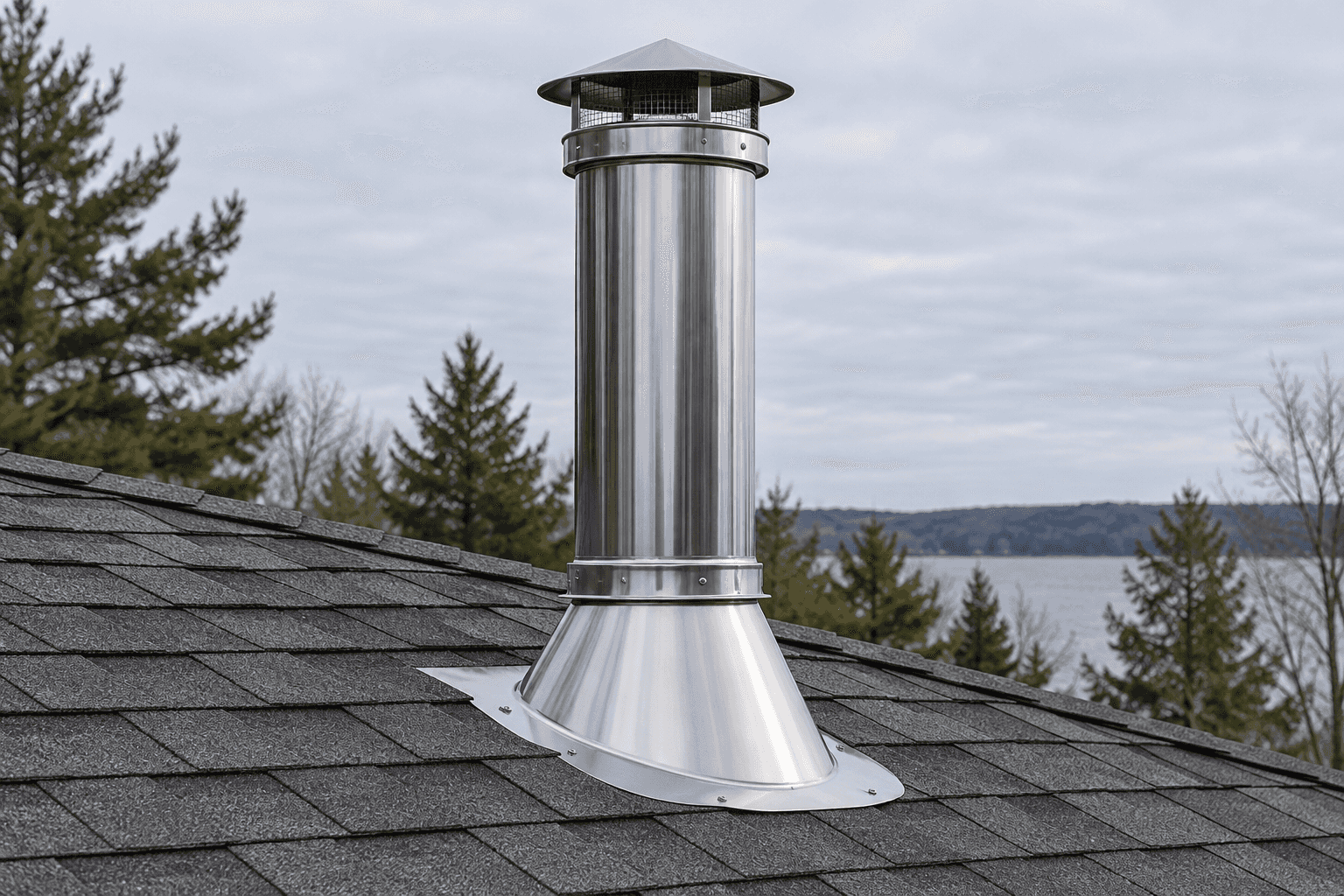
The stainless-steel chimney looks much tidier than the old brick one next door. That does not make it an ordinary roof pipe. Its visible tube belongs to an assembly with particular parts, supports and clearances.
Identify the chimney manufacturer and model before agreeing to replace its flashing. Have the roofing and chimney contractors decide who handles each part and what must be checked before the connected appliance returns to use. The useful quote describes more than a new metal cone.
Start with the label, not the outside diameter
Find the installation record and ask the chimney professional to photograph accessible identification labels. Include the connected stove, fireplace or other appliance in the discussion. Similar-looking metal systems can serve different equipment.
A measurement taken around the outside cannot establish which replacement parts are compatible. Selkirk's Canadian UltimateONE instructions, for example, specify certified parts and explain that the assembly's performance depends on its required supports and shields. Those instructions describe that system; they are not a parts list for every shiny chimney.
If identification is uncertain, allow time to resolve it before stripping the roof. Ask what can be confirmed from records, what requires a visit and whether the proposed parts are available. The morning the shingles come off is an inconvenient time to discover that a familiar-looking collar belongs to another product.
Follow the chimney through the reroof
The roof connection is one part of the assembly.
Identify
Find the model, labels and connected appliance.
Coordinate
Confirm compatible flashing, support and surrounding roof layers.
Protect
Agree temporary work and appliance-use restrictions.
Close out
Record changes, inspection scope and return-to-service instructions.
Name the pieces in the work scope
The roof flashing joins the chimney penetration to the roofing. A storm collar sits above the flashing connection around the chimney. The cap, chimney lengths and support arrangements have their own functions. Selkirk's Model CF drawing shows these as separate components, which is useful vocabulary even when the house has another model.
Ask the contractor to mark the proposed work on a photograph. Does "replace chimney flashing" include the storm collar? Will any chimney section or brace be disturbed? Is a deteriorated component being retained because it is outside the roofing quote?
For a masonry chimney, the questions differ. Our flashing-or-masonry guide follows brickwork, mortar and the crown. Do not borrow that repair scope for a factory-built metal assembly.

Check what the new roof changes
Changing shingles to another covering, adding above-deck insulation or repairing sheathing can alter the roof junction. Send the chimney professional the actual proposed layers and finished level, rather than simply saying that a reroof is planned.
For example, a thicker assembly may leave the existing flashing sitting differently relative to the chimney and roof surface. Have the two trades resolve the compatible detail before ordering it. The chimney's height, stability and supports should be reviewed where the work affects them.
The specialist also needs to know about work below the roof. New attic insulation or air sealing must respect the chimney's specified clearances and shielding. Selkirk explicitly warns against filling its required air space with insulation. An open-looking space beside a hot chimney is not automatically an air leak to fill with foam.
Agree on the workday sequence
Put three practical points in writing: who may dismantle components, how the opening and chimney are protected during the work, and who authorizes return to service. Include the appliance-use restriction in the household plan so somebody does not light the stove while a connection is incomplete.
Discuss weather delays too. A temporary covering around the roof opening needs an agreed removal and completion step. Nobody should have to infer that the chimney is ready because the roofing truck has left.
A flashing-reuse decision should identify condition and compatibility. It should also name any uncertainty that cannot be resolved until the old covering is removed, with a process for approving additional work.
Ask what the final inspection includes
Request a written account of the parts changed, checks performed and areas that remained inaccessible. WETT distinguishes inspection levels by access and investigation scope. Ask whether the proposed visit covers the roof-level work and any affected attic components; a ground-level look cannot reveal every concealed connection.
Keep the model information, applicable instructions and completion photographs together. A history of a chimney fire belongs in that file and calls for the appropriate assessment before reuse.
The finished roof should shed rain, and the chimney work should have its own clear completion record. Both matter when the first cold evening arrives.