

The clay sample is the colour of the older brick on your house. You have already pictured it above the front door. Then someone asks whether tile survives an Ontario winter, and the conversation turns into a collection of reassuring photographs from warmer places.
Some clay and concrete tile systems suit cold climates; the exact product, complete roof design and local repair support decide whether one suits your house. Keep the sample. Put its freezing-exposure evidence and installed weight beside it before choosing a colour for the ridge pieces.
Ask for the exact product's freezing-exposure evidence
Clay tile is fired ceramic; concrete tile is a cement-based product. Either name covers a range of shapes, finishes and specifications. Appearance does not tell you whether a particular product is suitable for repeated freezing exposure.
Request the manufacturer's cold-climate documentation and installation instructions for the proposed model. Westlake Royal's tile resource library separates product information from installation and cold-climate documents. That is the level of specificity to expect. A photograph of a tiled house in a warm region answers the colour question, not the winter question.
For a heritage repair, matching the visible profile can be only part of the problem. The replacement also needs compatible dimensions, attachment and performance. Confirm local heritage requirements before substituting a different material or profile.
Four Gates Before Ordering Tile
A suitable tile needs evidence at every gate.
Exact model
Confirm clay or concrete profile and cold-exposure documentation.
Whole load
Use installed tile weight plus the complete supporting assembly.
Winter details
Coordinate underlayment, flashing, snow management and drainage.
Future repair
Identify local service, compatible pieces and any heritage approval.
Check the load before choosing a colour
A tile conversion can add substantial permanent weight compared with an existing shingle roof. Use the selected system's installed weight, including its supporting components. Do not assume that a roof carrying winter snow therefore has spare capacity for heavier roofing throughout the year.
Have the structure assessed for the proposed assembly and applicable loads. Existing spans, alterations, condition and support matter. A salesperson's statement that another house accepted the same tile does not assess yours. Where structural changes are proposed, confirm the municipal permit requirements; Toronto's permit guidance includes structural alterations.
This review can make the decision early. If reinforcement would require disruptive work through finished rooms, comparing lighter materials before detailed tile selection saves a lot of redesign.
The red clay sample wins the kitchen-table vote before Mike opens the technical sheet. Pat turns it over and asks about the roof framing. Nobody came to the meeting hoping to discuss framing, but it has rather strong opinions about extra weight.
Dave keeps the sample beside the documents. The appearance is still part of the decision. So are the exact profile's weight, evidence for the exposure and a repair supply. Choosing the look gets easier once the proposal explains what keeping it involves.
Compare a Named Tile, Not a Material Average
Westlake Royal's 1-Piece S and ClayLite layout guide lists approximate tile weights of 800 and 590 pounds per roofing square respectively at its recommended headlap. A square is 100 square feet, so those examples are 8 and 5.9 pounds per square foot for the tiles. They are not complete roof loads or an endorsement of either product for this Ontario house.
The distinction is useful even before a purchase. A lighter tile still needs its own freezing-exposure evidence; low weight does not establish cold-climate suitability. Battens, underlayment, accessories and any changed deck also belong in the structural assembly calculation. Do not subtract an old roof weight guessed from its appearance.
For each clay or concrete option, keep the same five lines beside the sample: exact profile, evidence for the intended exposure, installed assembly weight, local installer and replacement-piece supply. Clay and concrete are different manufacturing routes, but a category-wide promise is less useful than those product-specific answers.
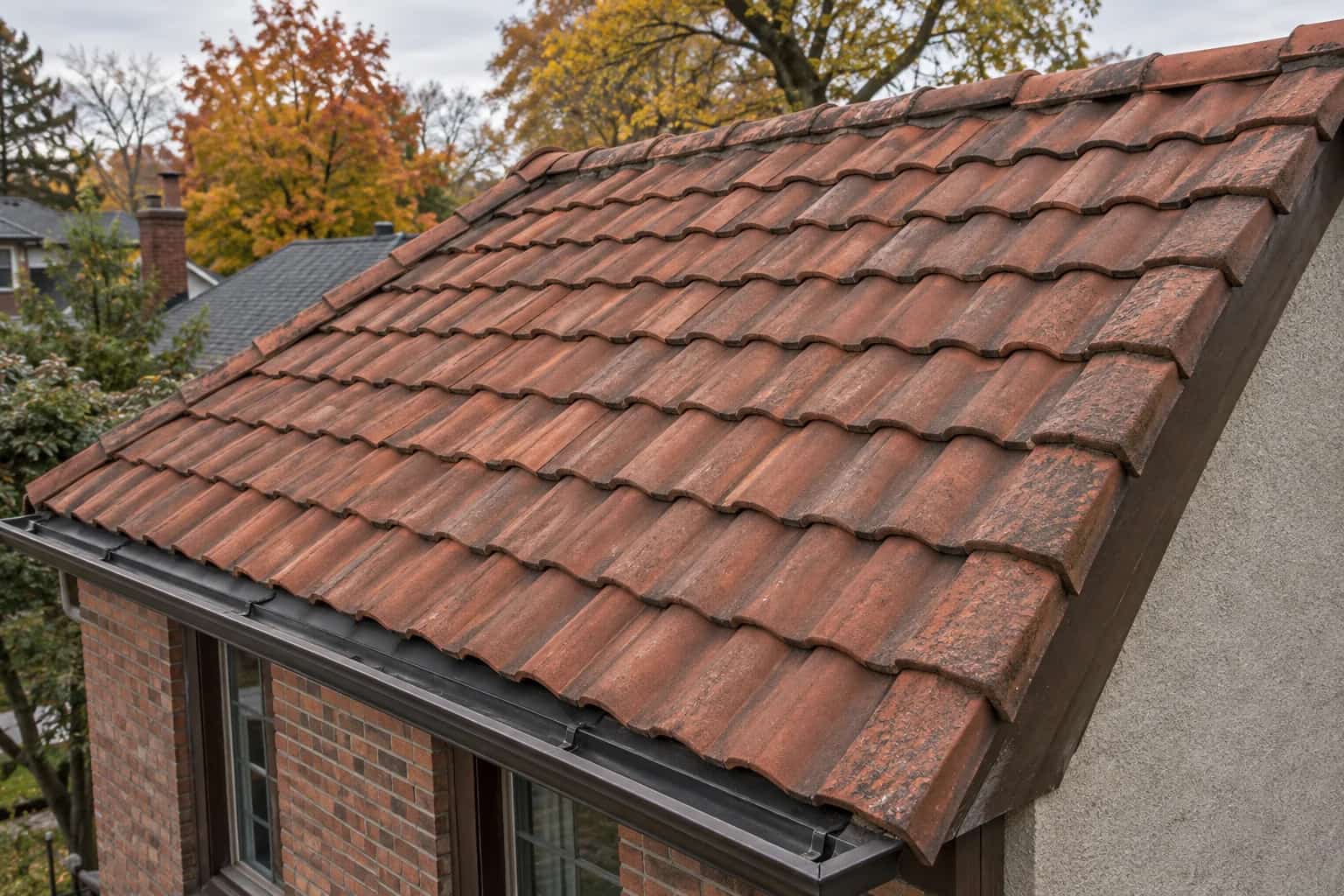
Winter details extend below and beyond the tiles
The covering, underlayment and flashing need to work as an assembly. Wind-driven precipitation, penetrations, valleys and roof edges still need designed water control. Do not let a long tile life expectancy become an excuse to ignore shorter-lived or inaccessible components beneath it.
Snow and ice also affect entrances, lower roofs and paths below. Snow-retention hardware, where required by the design, must be compatible with the tile and its support. It is not a collection of generic brackets added wherever they look tidy.
Buy the repair plan with the roof
Tile can be damaged by careless access. Future chimney, antenna or gutter work should be planned with someone familiar with walking and working on that roof system.
Before ordering, identify the local installer, source of compatible replacement pieces and approach to replacing a damaged tile without harming its neighbours. Ask whether keeping a small matching spare supply is sensible for the selected line. A material can be technically suitable yet awkward to own if every minor repair depends on an uncertain import.
If the product evidence, structure and service plan work, return to the colour samples with a much better question answered. You know what choosing that look will involve.