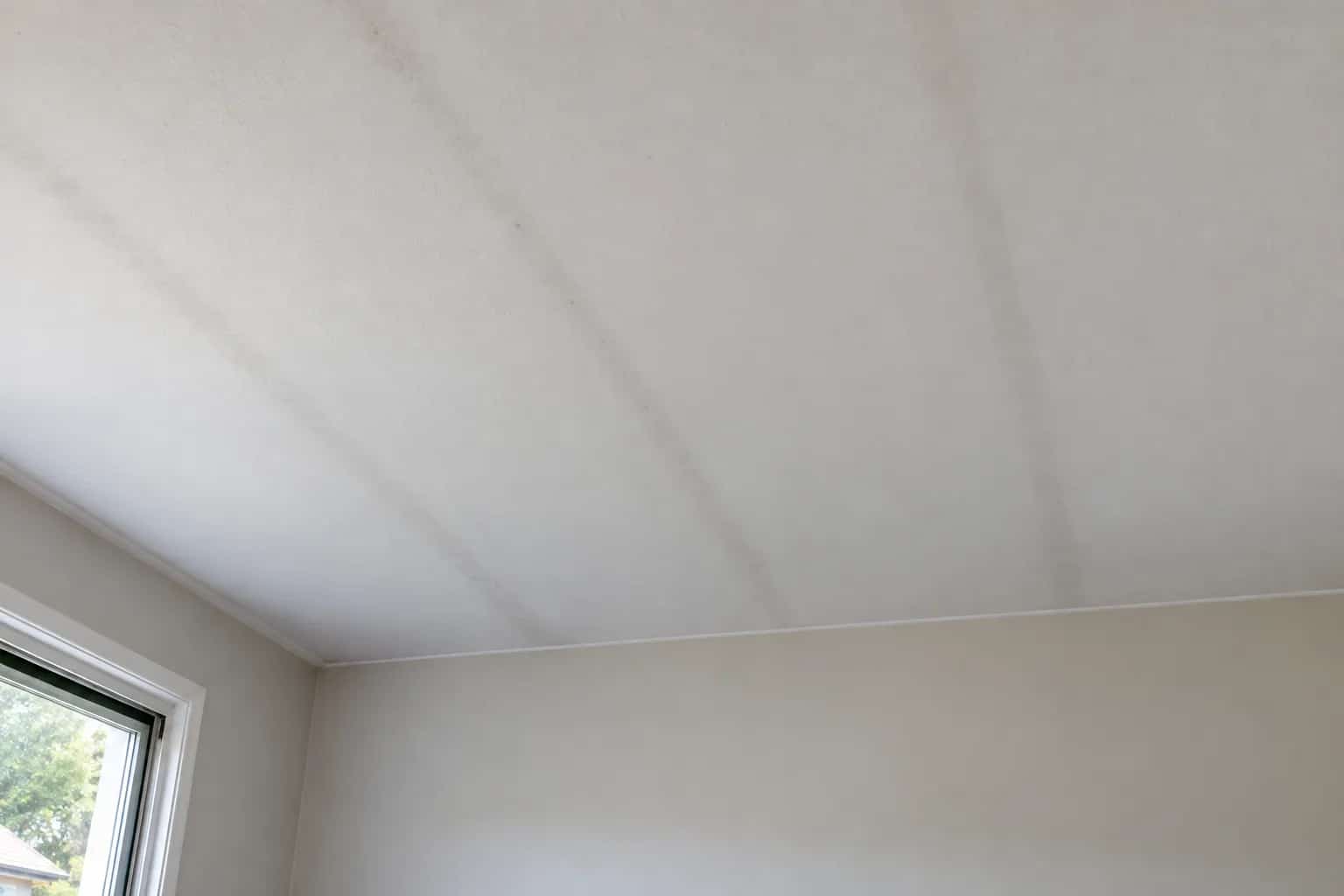
In afternoon light, faint grey lines appear across the bedroom ceiling. The homeowner follows one with a finger from the floor. It seems remarkably straight for a leak.
Pat looks at the pattern, then at a separate brown mark in the corner. "Let's keep those as two questions."
Regular lines can be ghosting: particles collecting in a pattern associated with cooler surfaces or air movement. They can follow framing without being rain stains. But the pattern does not identify the deposit or prove that a separate mark is dry.
Why the Pattern Can Follow the Framing
Timber and insulation transfer heat differently. Where the construction creates a colder strip at the room-facing surface, tiny airborne particles can deposit more readily. Repeated framing positions can then become visible through the deposit pattern.
Building Science Corporation's investigation of ghosting describes cold-surface deposition, filtration and other particle-deposition mechanisms. Potential particle sources include smoke from candles, tobacco and fireplaces, as well as fine dust. The source and the place it collects may be in different parts of the room.
That explains why repainting alone can be disappointing. A fresh surface has not changed the particles in the air or the surface-temperature pattern. The marks may return without a single drop coming through the roof.
Compare Shapes, Then Check Conditions
A regular sequence of faint lines suggests a different starting point from an irregular stain spreading during rain. Small recurring dots may align with fasteners. A dark strip along an air path may have another explanation again. These are useful descriptions, not diagnoses.
Consider a bedroom with faint parallel marks but unchanged, intact finishes through several storms. Now compare a ceiling with those same lines plus a newly damp corner. The first deserves an assessment of deposits and construction patterns. The second also needs the wet corner investigated; the label ghosting should not explain away a separate leak.
Colour is not a mould test. Health Canada's moisture guidance recommends investigating dampness, deterioration and musty odours, including hidden moisture where indicated. A grey mark is not automatically mould, and a pale mark is not automatically harmless.
Make a Pattern Record, Not a Diagnosis
A useful record has three views: the whole ceiling with the lines visible, a closer view of one line, and the same area after a relevant weather event. Note whether the lines are evenly spaced, whether they align with known framing and whether any separate patch changes after rain.
Ask the assessor which finding supports particle deposition, which supports current moisture and what remains untested. The two marks in the bedroom need not share one explanation.
Separate the pattern from the cause
Similar-looking marks can need different investigations.
Parallel faint lines
Record spacing and possible alignment with framing.
Irregular changing patch
Investigate fresh wetting and its trigger separately.
Temperature pattern
Thermal imaging can show differences, not identify a deposit.
Confirmed finding
Choose cleaning or repair after moisture and surface conditions are assessed.
What a Useful Inspection Separates
The inspector should distinguish the surface deposit from the reason it collected there. That may involve moisture checks, comparison with framing positions, insulation continuity and suspected air routes. A thermal image can help locate temperature differences; it does not identify the chemistry of a dark mark.
An air-leakage investigation has a different purpose from checking a roof flashing. NRCan's air-control guidance explains the role of a continuous air barrier. Adding more loose insulation is not automatically a repair for a gap through which air moves.
Describe any recent change: more candle use, interior sanding, a change in heating operation, or the first winter after a renovation. These clues can narrow the inquiry without turning the visit into a guessing game about one favourite suspect.
Clean Up the Cause Before the Finish
The room record now has two entries instead of one reassuring label: parallel marks across the ceiling, and a corner mark whose wetting history still needs checking. That is a better starting point than painting everything and hoping the ceiling chooses one explanation next winter.
Once the deposit and contributing conditions are understood, the response can be proportionate: source control, appropriate cleaning and decorating, or targeted enclosure work where a defect is found. Mould or concealed moisture calls for its own assessment before cosmetic work.
Do not begin by sanding an unidentified deposit overhead. Preserve a wider photograph showing the spacing and room landmarks, then let the finding decide the cleanup. If the central question is whether an old stain is getting wet again, the dry-or-active guide covers that test of time. A regular pattern helps direct the assessment; it does not replace it.