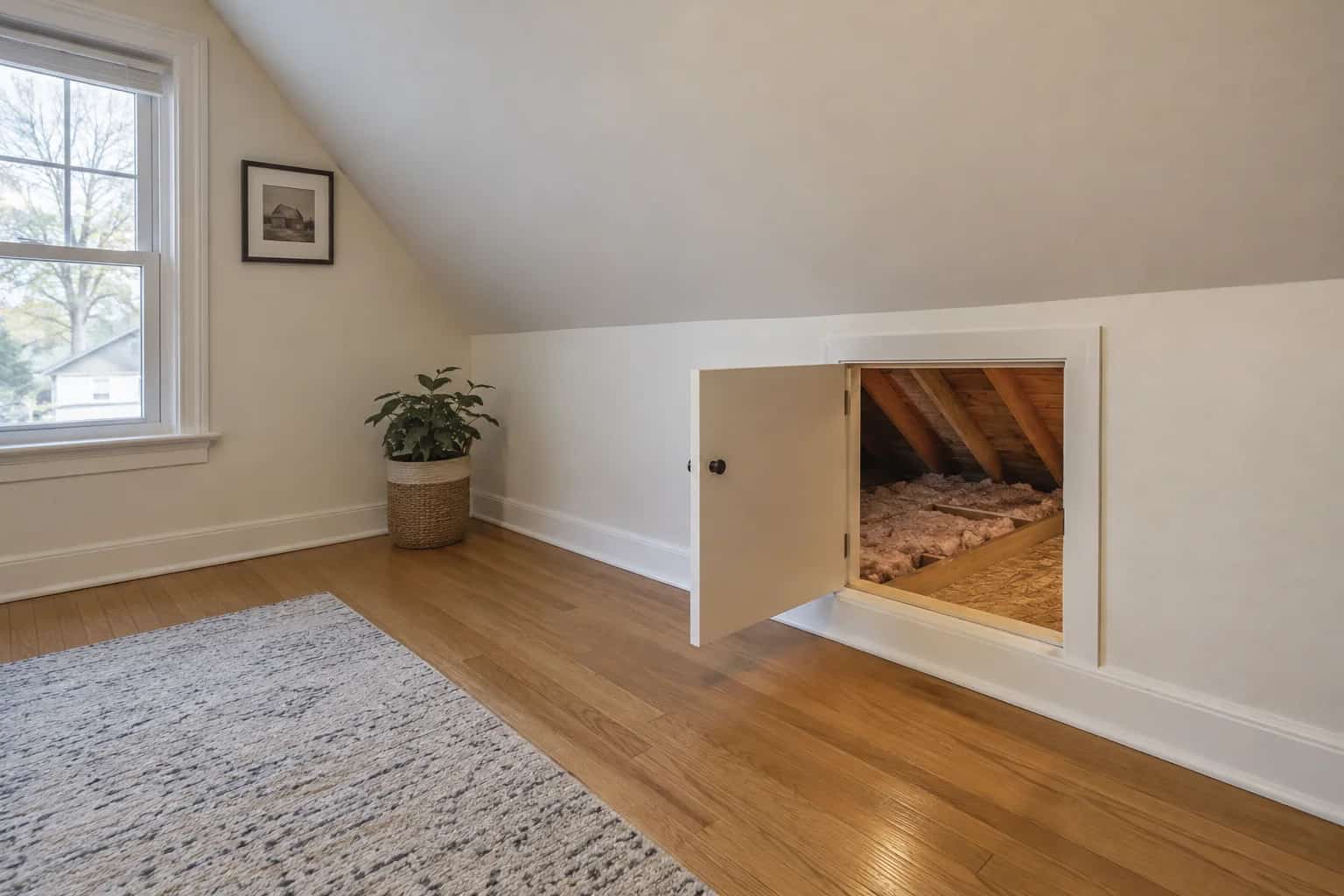
The owner asks whether he should crawl across the insulation for a better photograph. Dave declines the offer. The pale surface looks continuous, but it may conceal only ceiling plaster or drywall between framing. Do not step onto it. Visible timber does not establish a safe route through wiring, trusses, nails and concealed materials.
An Open Hatch Is Not Permission to Enter
Mike asks for the room sketch and leak dates instead. The owner can contribute a great deal to the inspection without entering the attic. A room sketch locating the stain, a date for the first drip and a note that it followed a thaw may be more helpful than another close-up of insulation. The professional's job is to reach the relevant area safely and connect those observations to the construction.
From safe access, a professional may be able to photograph the general roof space, insulation surface and nearby ducts without moving through it. The limits should be recorded. Pat labels the photographs "view from hatch" so their limits travel with them. A sharp image is still only a view of the places it shows; it cannot establish remote eave or hidden-valley condition.
Do not stretch across the hatch to reach a duct, balance on the trim or move insulation to search for a foot placement. A dropped phone is an inconvenience. A step through the ceiling is a much worse way to obtain a photograph.
Choose the Safest Evidence Route
Gather what is accessible, then arrange the access the diagnosis actually needs.
Observe from occupied space
Record stains and timing without disturbing the ceiling.
Document safe visible areas
Use professional hatch-view photographs where access is suitable.
Identify missing evidence
Name remote or concealed areas that remain uninspected.
Plan qualified access
Arrange a supported route or targeted opening appropriate to the task.
Ask How the Inspector Will Reach the Area
A suitable access plan depends on the framing and task. Temporary work platforms or routes must be supported appropriately; random boards laid across unknown members do not establish safety. Structural questions need qualified assessment.
The Natural Resources Canada attic guidance identifies access, structural conditions and health or fire hazards as preliminary considerations. They are part of the inspection, not details to improvise after someone has climbed in.
If suspect vermiculite, animal contamination, damaged wiring or extensive moisture damage is present, additional assessment may be needed before ordinary entry. Tell the contractor about anything already known so they arrive prepared.
What "not observed" means
A report should distinguish "not observed" from "confirmed sound." If the far eave could not be reached, ask what alternative access or targeted investigation would be needed and whether the symptom justifies it.
For repeated service access, discuss a designed walkway, suitable lighting and a usable hatch with the appropriate professionals. When the owner mentions Christmas boxes, Dave separates that idea from the service walkway. Easier access does not automatically create a storage floor. A convenient place to put a box is not yet a structural assessment.
A service walkway and a storage floor are separate decisions; our attic storage guide explains why. For an inspection, you need the findings and the access limits explained. You do not need to follow the inspector into the attic.