
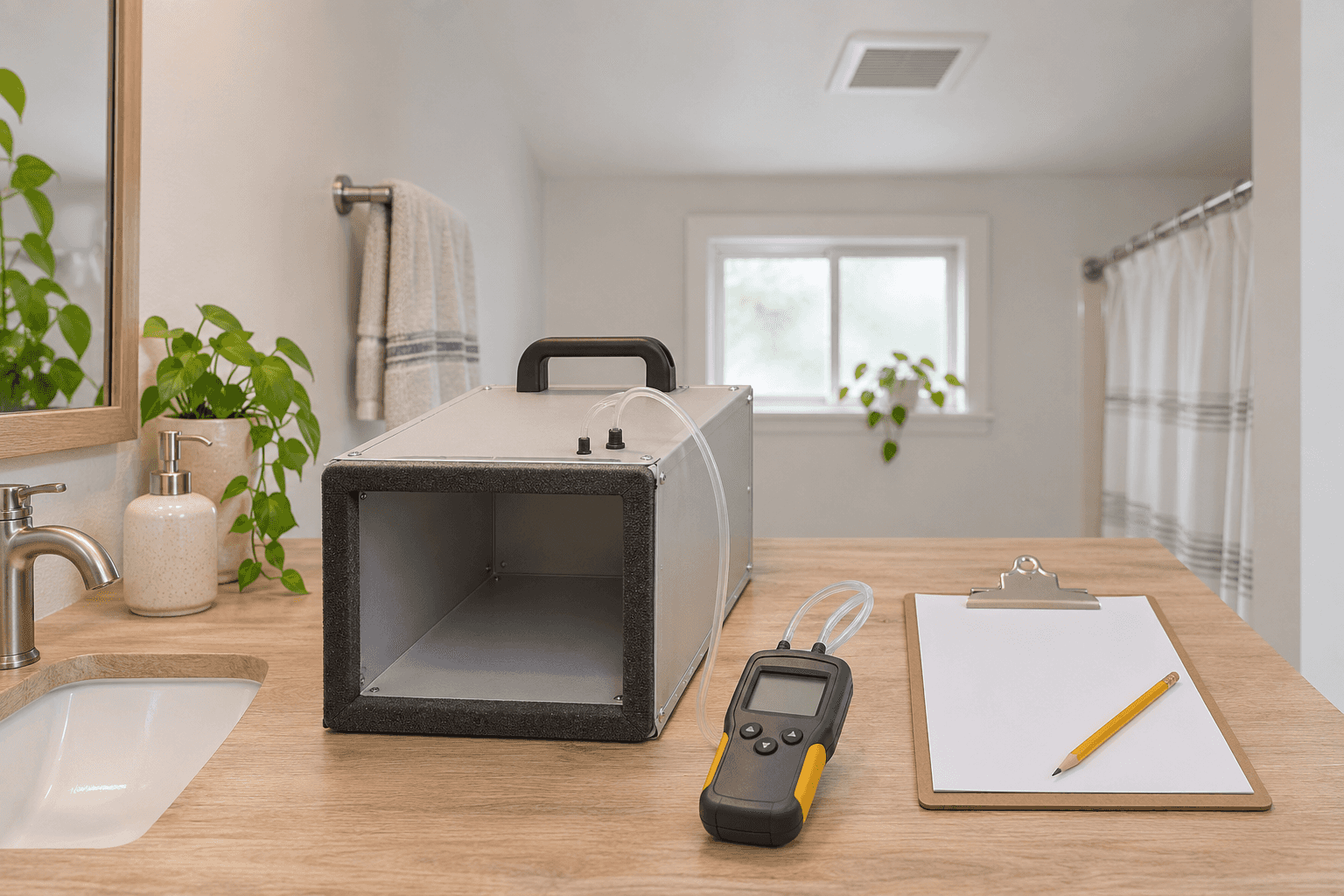
A useful bathroom-fan test report gives the measured airflow, how it was measured and the conditions in the room. It also identifies the airflow the installation is meant to deliver. "Fan works" is a conclusion. You need the working underneath it.
This is the next step when an installer has recommended an airflow check. It is not another way to judge the fan by its noise or the bathroom mirror.
Keep the product rating separate from the measurement
CFM means cubic feet per minute. A product's airflow rating describes performance under stated test conditions. HVI explains that its certified airflow, sound and energy ratings come from independent laboratory testing.
Your installed fan also has a duct, bends, dampers and an outdoor terminal. Those create resistance. A box marked 80 CFM does not establish that the bathroom receives 80 CFM after installation.
Ask which speed or control setting was tested and which product rating is being compared. ENERGY STAR's fan criteria distinguish airflow at different static pressures. Its certification criteria are not a pass mark for an airflow test in every Ontario bathroom.
Three different things on the same report
They answer different questions; keep each one labelled.
Rated airflow
What the named fan delivers under the stated laboratory test conditions.
Measured airflow
What a suitable instrument found at the documented location and operating setting.
Required or designed airflow
The target the installer identifies for this actual bathroom and ventilation system.
Ask what the instrument actually measured
PNNL's measurement guide describes capture hoods and other airflow methods, with different applications and limitations. The technician should select a suitable method for the system, explain the measurement location and use the instrument's instructions.
A report should name the instrument and method, record the airflow with its units, and note a limitation that could affect the result. Air speed at one spot on a grille is not automatically the total volume passing through it. Nor does a tissue held against the grille supply a CFM reading. The tissue has not secretly become a calibrated instrument.
A shared remote fan needs particular care: the method must suit a system with more than one inlet. Ask for the result at each bathroom, not just a single total beside the motor. Our shared-fan guide explains that layout.
Put the room conditions beside the number
Record the bathroom door position, fan setting and relevant controls or other ventilation operating during the check. Where an open-door comparison is useful, keep it separate from the normal-use result.
If the fan performs better with the door ajar, the replacement-air guide explains why that matters. A higher open-door reading does not prove that the bathroom will work well with the door closed for privacy.
Keep a short record you can read later:
- Bathroom and fan model, date and operating setting.
- Instrument, method, measurement location and units.
- Door position and relevant ventilation settings.
- Measured result, intended airflow and the basis for that target.
- Limitations, proposed correction and any repeat-test result.
Use a low result to choose the next check
Ask the installer to identify the applicable design, product or local requirement before declaring a pass or failure. A generic internet CFM rule cannot settle every existing house, shared system or renovation.
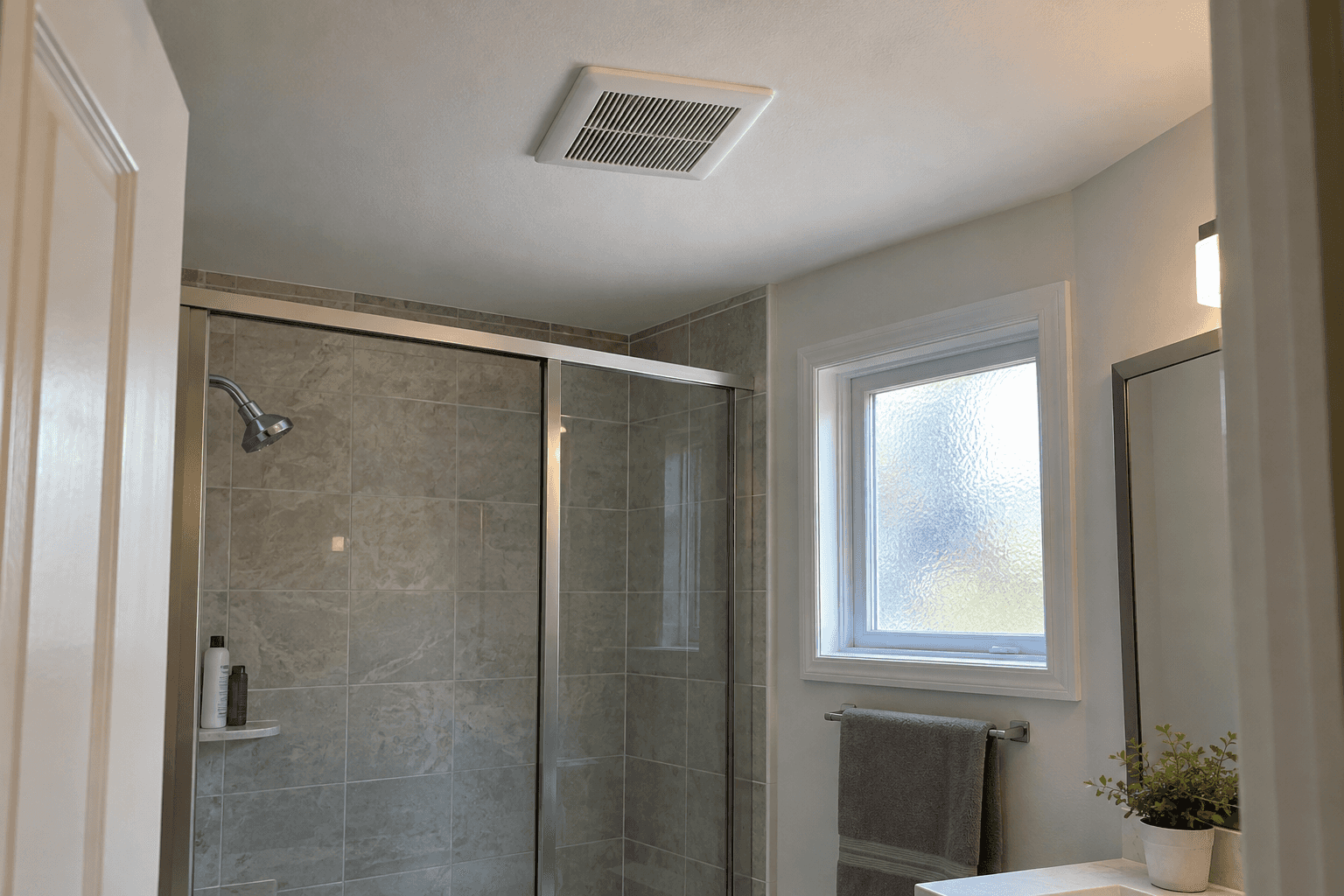
If measured airflow falls short, investigate the whole route: replacement air, duct condition, damper operation and the outdoor outlet. A low number does not identify which part failed. A larger motor is not the automatic answer.
After corrective work, compare results under the same documented conditions. Keep both readings and what changed. Even adequate airflow at the grille does not, by itself, prove that a hidden duct is connected all the way outdoors or that its roof flashing is sound. The outlet-route guide covers those separate checks.
Leave ceiling access, electrical work and roof-terminal inspection to suitably equipped people. The homeowner's useful job is to keep the conditions and findings together, so the next visit starts with evidence instead of another guess.