
Skylights are the most leak-prone feature on a residential roof. Not because they're bad products, but because the flashing around them is hard to get right and easy to rush.
We replaced a 22-square ranch-style roof in Vaughan that had two skylights and a chimney. The shingles were 20 years old and due for replacement. The skylights looked fine from outside. They were not fine.
What we found
When we stripped the shingles and underlayment around the first skylight, the decking was soft. Not rotten, but visibly darker and spongy at the edges. The plywood had been absorbing moisture for years.
The source: the original flashing kit was a pre-formed one-piece unit. These kits work when they're new, but after 15+ years of freeze-thaw cycling, the sealant between the flashing and the skylight frame dries out and cracks. Water wasn't pouring in. It was wicking. Capillary action pulled small amounts of moisture under the flashing lip during every rain, slow enough that the homeowner never saw a drip inside.
The second skylight had the same issue. Both had condensation staining visible only from the underside of the decking, in the attic. From the roof surface, everything looked normal.
Why skylight flashing is difficult
Every skylight sits in a hole in your roof. The roof is designed to shed water. A skylight interrupts that flow, creating four joints where water wants to enter: the head (top), the sill (bottom), and both sides. Each joint needs its own flashing treatment.
Step flashing at the sides must interweave with each course of shingles. Miss one overlap and water bypasses the flashing entirely.
The head flashing (the top edge) takes the most water. It needs a kick-out that diverts flow around the skylight without pooling behind it. On this ranch roof with a moderate 5/12 pitch, water doesn't move fast enough to clear the skylight on its own. The head flashing does the work.
Counter flashing over the step flashing seals the gap between the skylight frame and the step flashing. This is where most failures happen. Caulk is not flashing. We see "flashed" skylights that are actually just caulked. It holds for 3–5 years, then cracks.
How we handled it
We replaced both sheets of soft decking. Then we installed ice-and-water shield in a continuous run around each skylight, extending 12 inches past the frame on all sides. New step flashing on both sides, new head flashing with a proper diverter, new sill flashing that overlaps the shingles below. We counter-flashed with bent aluminum, mechanically fastened and sealed, not just caulked.
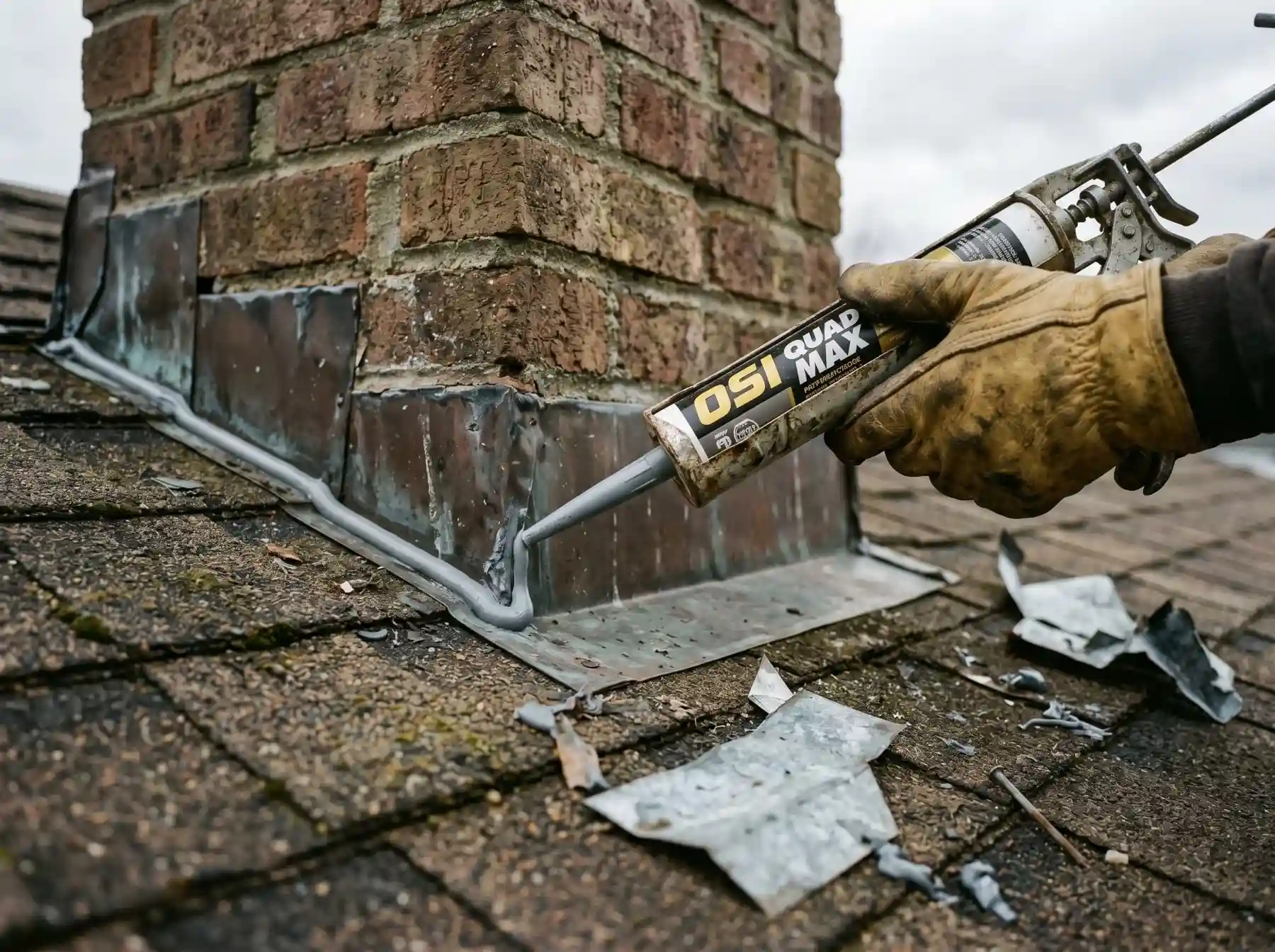
The chimney got the same treatment: new counter flashing set into the mortar joints, new step flashing on both sides, ice-and-water shield at the base.
The numbers
The flashing work on the two skylights and chimney accounted for about 4 hours of the 2-day job, roughly 25% of the total labour on a job where flashing accounts for maybe 5% of the surface area. That ratio tells you why so many roofers rush it.
What to check on your roof
If your home has skylights and the roof is over 15 years old, look at the ceiling around the skylight frame from inside. Any discolouration, bubbling paint, or musty smell means moisture is getting in. Don't wait for an active drip. By the time you see water, the decking has been absorbing it for years.
When you get a roofing quote, ask specifically how the crew will handle the skylights. "We'll re-flash them" is too vague. You want to hear about ice-and-water shield, step flashing, head flashing, and counter flashing as separate items.